
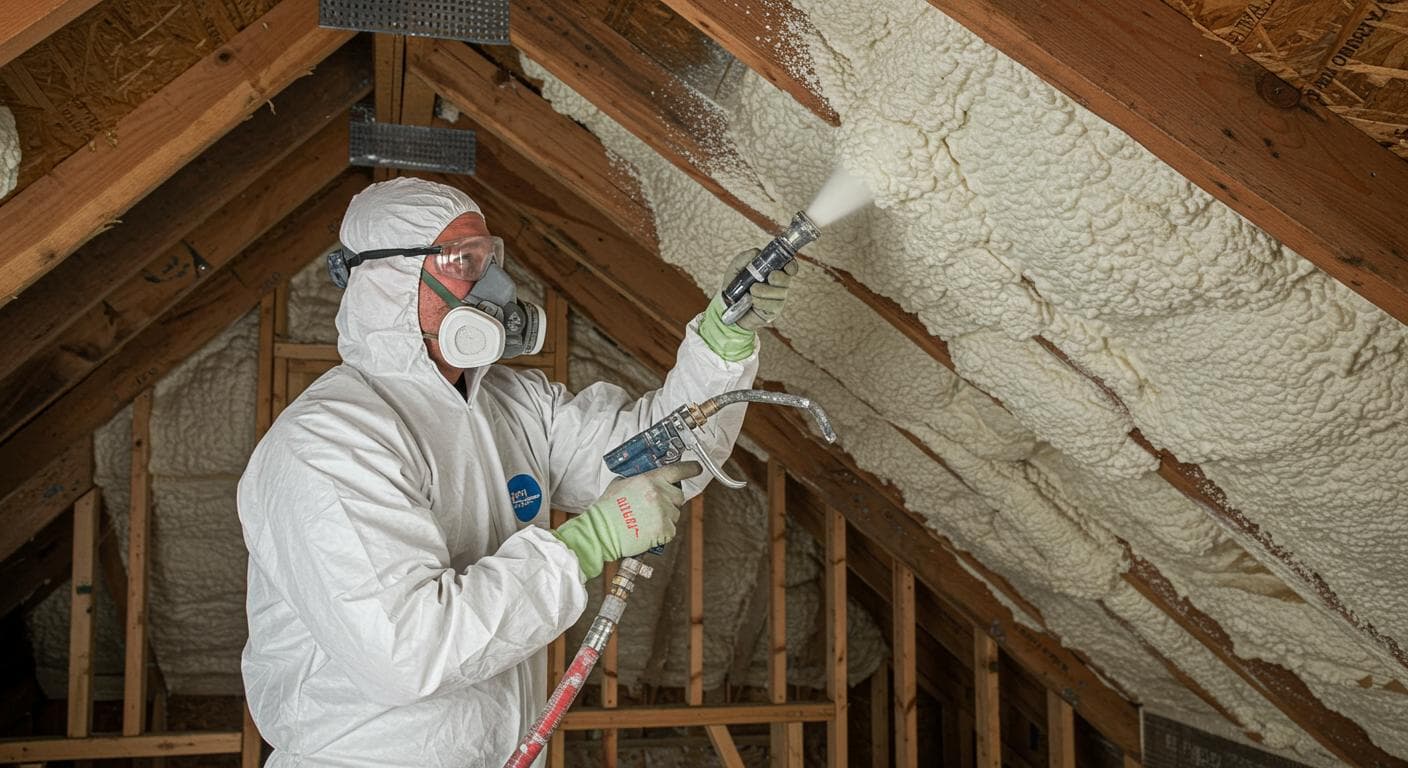
You asked two companies about insulating the attic. One quoted spray foam on the underside of the roof. The other quoted blown-in insulation on the attic floor for a fraction of the price. Now you are not sure which one to trust.
The spray foam vs blown-in insulation question does not have one right answer. Each is the better pick in a different part of the house. This guide explains how each one works, how they compare on R-value, air sealing and price, and how to tell which one fits the job in front of you. Neither one is a bad product. The mistake is using either one in the wrong spot.
What Each One Is
Blown-in insulation (loose fill)
Small pieces of cellulose, fiberglass or mineral wool blown into place with a machine. It piles up on an attic floor or packs into closed wall cavities, and it fills around wires, pipes and odd shapes without cutting. ENERGY STAR lists it as best suited to unfinished attic floors, enclosed walls and other hard-to-reach places.
Spray foam
A liquid sprayed onto a surface that expands into foam and hardens in place. It sticks to wood and fills cracks as it grows, so it insulates and blocks air at the same time. It comes in two types: open-cell, which is soft and light, and closed-cell, which is dense and rigid.
Spray Foam vs Blown-In Insulation, Side by Side
The figures below come from the Department of Energy's Guide to Home Insulation (2010) and ENERGY STAR's attic insulation page.
R-value per inch
Common loose fill adds about R-3 to R-3.5 per inch. Open-cell foam rated about R-3.6 per inch in the DOE guide, close to loose fill. Closed-cell foam rated about R-6.5 per inch, nearly double. That matters where space is tight, not on an open attic floor with room to pile up depth.
Air sealing
Spray foam seals gaps as it goes on. Blown-in insulation slows heat but lets air pass through, so the gaps in the attic floor need to be sealed separately before it goes in. With good air sealing first, blown-in performs well.
Price for the same R-value
In the 2010 DOE guide, installed loose fill cost about 3 cents per square foot for each point of R-value. Open-cell foam cost about 17 cents and closed-cell about 25 cents. Today's prices are different, but the gap is the point: for the same warmth, blown-in costs a fraction of spray foam.
Who installs it
ENERGY STAR rates loose fill as an intermediate job (some stores rent the blowing machine) and sprayed foam as an advanced job that needs a trained installer with protective gear.
Changing your mind later
Blown-in can be topped up, moved aside for a repair or vacuumed out. Cured spray foam is stuck to the wood and hard to remove, which makes later roof, wiring or plumbing work in that area slower.
Where Each One Makes Sense
Open attic floor: usually blown-in
There is room for depth, so the R-value per inch matters less than the price per R. Seal the air leaks in the attic floor, set baffles at the eaves and blow in to the level for your climate zone.
Underside of the roof: spray foam
When the attic holds a furnace or ductwork, or you want to use it as finished space, insulation often moves up to the roof deck. Foam fits there because it sticks to the slope and seals it. This changes how the attic is vented, so it needs a pro who designs it as a whole.
Basement rim joists: spray foam
The band of wood on top of the foundation wall is full of gaps and small pockets. Foam seals and insulates it in one step.
Closed walls in an older house: blown-in
Loose fill can be blown into empty wall cavities through small holes without tearing out the walls.
Open new walls: either
During a remodel, with the studs open, both work. Foam costs more and seals better. Blown-in or batts cost less and need air sealing done carefully.
Whichever you choose, the attic still needs a dry roof and working vents unless it is being designed as a sealed space. Damp insulation usually means a roof leak, and our roofing pros should fix that first. Getting the attic right also helps stop ice dams, as our ice dam prevention guide explains.
Check This Before You Compare Quotes
The one thing you can check yourself
Before you compare spray foam vs blown-in insulation quotes, look up into the attic with a flashlight. Is there a furnace, an air handler or ductwork up there? If not, the floor is usually where the insulation belongs, and blown-in is the normal choice. If there is, ask each company to explain in writing why they chose the floor or the roof deck. Two quotes that insulate different surfaces are not the same job, so do not compare them on price alone.
Questions to Ask the Insulation Pro
Ask for these in writing
· Which surface you are insulating (attic floor, roof deck, walls or rim joists) and why
· The material and the final R-value, plus the settled depth for blown-in
· What air sealing is included before any loose fill goes in
· For spray foam, open-cell or closed-cell, and how long the house must stay empty while it cures
· Whether old insulation has to come out first, and who handles it
The price moves with the size of the space, the material, the depth or thickness, how much air sealing comes first, whether old insulation has to be removed and how hard the space is to work in. Many utilities offer rebates for air sealing and insulation, so check with yours before you sign. Ask to see the installer's license and proof of insurance where your state or city requires one.
Spray Foam vs Blown-In Insulation: Common Questions
Is spray foam better than blown-in insulation?
Not across the board. Spray foam packs more R-value into each inch and seals air leaks as it goes on, so it shines in tight spaces like walls, rim joists and roof decks. On an open attic floor with room for depth, blown-in insulation reaches the same R-value for much less money once the air leaks are sealed.
Which is cheaper, spray foam or blown-in?
Blown-in is cheaper for the same R-value. In a Department of Energy insulation guide from 2010, installed spray foam cost roughly 6 to 8 times more per unit of R-value than loose fill. Prices have changed since then, but the gap between the two is the reason most open attic floors get blown-in insulation.
What is the difference between open-cell and closed-cell spray foam?
Closed-cell foam is dense and rigid and gives more R-value per inch. In the Department of Energy guide, 1 inch of closed-cell rated about R-6.5, while 3.5 inches of open-cell rated about R-12.6, or roughly R-3.6 per inch. Open-cell is lighter, softer and cheaper. Ask the installer which type suits the spot you are insulating.
Can I install spray foam myself?
Small cans of foam for sealing gaps are a normal DIY tool. Whole-wall or whole-roof spray foam is not. ENERGY STAR rates sprayed foam as an advanced job that needs a trained installer. Ask the installer how long the house must stay empty while the foam cures, and follow it.
Can blown-in insulation go on top of old insulation?
Usually yes, if the old insulation is dry, clean and not vermiculite. ENERGY STAR says loose fill can go on top of fiberglass batts and the other way around. Seal the air leaks in the attic floor first, because they are much harder to reach once more insulation is on top.
Does blown-in insulation settle?
Loose fill can settle a little over time, so installers usually blow in a bit more than the target depth. Ask the pro for the settled R-value and depth in writing, and check that the attic has depth markers so you can see it later.
Find an Insulation Pro
Start with our insulation services. Insulating a basement as part of a remodel? See our basement finishing pros.
Contractor Palace
The right insulation in the right spot.
Tell us which part of the house you want to insulate. We match you with one independent local pro, with the material, R-value and price in writing.