
Insulation near me. Insulation, local.
Ohio winters demand proper insulation. Our certified installers handle blown-in attic insulation, batt insulation and closed-cell spray foam for new builds and retrofits. Proper insulation cuts heating bills by 15-25%, and we're building the same certified network across Colorado's colder Front Range climate zones.
What is insulation?
Insulation is the thermal barrier between your living space and Ohio's extreme outdoor temperatures and it's often the single highest-ROI home improvement you can make. Ohio sits in climate zones 5 and 6, meaning current energy code requires R-49 to R-60 in attics and R-13 to R-21 in walls. Many Ohio homes, especially those built before 1980, fall well short of these requirements.
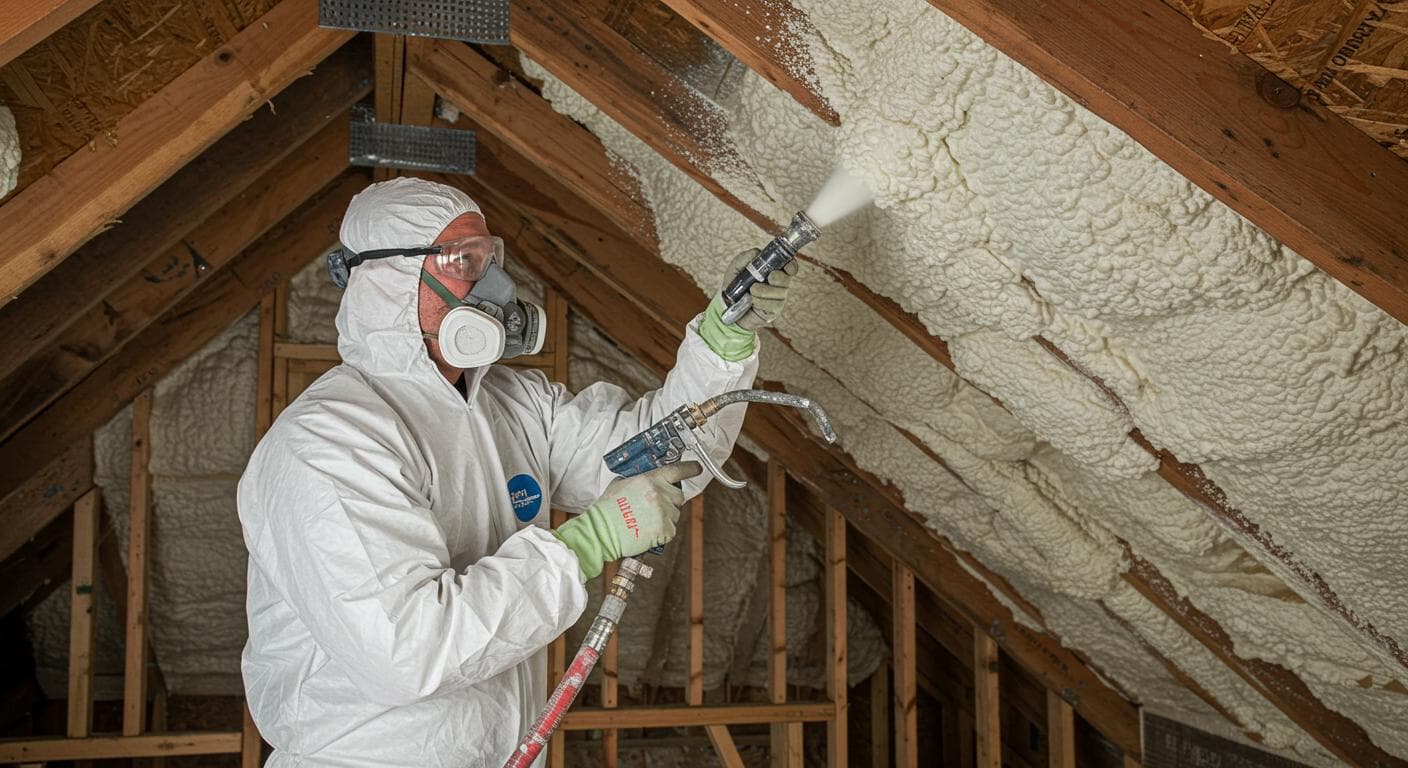
Insulation types used in Ohio homes include blown-in fiberglass or cellulose for attic top-ups (the most common retrofit), batt insulation for wall cavities in new construction or open walls during renovation, closed-cell spray polyurethane foam for rim joists, crawl spaces and hard-to-reach areas and open-cell spray foam for interior applications where vapor control is less critical.
Properly air-sealing before insulating is equally important, all the insulation in the world doesn't help if conditioned air is escaping through penetrations around wiring, plumbing and recessed lights. Our installers air-seal first, then insulate and verify performance with thermal imaging after completion.
Ohio's cold winters mean attic insulation upgrades typically pay back within 3-7 years through reduced gas and electric bills.
What homeowners should know.
Insulation is the single highest-ROI home improvement for most Ohio homeowners, yet it's frequently underdone, particularly in homes built before 1980. Ohio sits in climate zones 5 and 6, requiring R-49 to R-60 in attics. Many existing Ohio homes have R-19 to R-30 in the attic, roughly half of what current code requires. Adding blown-in insulation to bring attic levels up to code costs $1,000 to $2,500 for a typical Ohio home and pays back in 3 to 5 years through reduced heating and cooling costs.
Brands matter for spray foam applications. Owens Corning, Johns Manville and CertainTeed are the major insulation material manufacturers used by Ohio contractors. For blown-in applications, cellulose (made from recycled newspaper) and fiberglass are both effective, cellulose has slightly better air-sealing properties, while fiberglass is moisture-resistant. For spray foam specifically, correct mixing ratios are critical: off-ratio foam underperforms and can off-gas indefinitely. Only trained applicators with manufacturer certification should install closed-cell spray foam.
The rim joist, the band of framing running around the perimeter of the basement where the floor system meets the foundation wall, is the most underinsulated area in most Ohio homes. Cold floors on the first floor in winter, even with an insulated crawl space, are often traced to uninsulated rim joists. Closed-cell spray foam applied to the rim joist at 2 inches depth (R-13) eliminates this heat loss point in a 1 to 2 hour job that runs $400 to $1,000.
Air sealing before insulating is non-negotiable. Penetrations for wiring, plumbing, HVAC ducts and recessed lights are major air leakage paths, caulking and foam sealing these before adding insulation delivers 30 to 50% more energy savings than insulation alone. Ohio utility companies AEP Ohio, Columbia Gas and Duke Energy all offer rebates for qualifying insulation and air sealing projects, ask your installer for documentation to claim available incentives.
Crawl space encapsulation, sealing the ground and walls with a vapor barrier plus mechanical dehumidification, addresses humidity-driven moisture that damages floor joists and degrades first-floor comfort. Homes with crawl spaces in Ohio that have never been encapsulated almost always show elevated moisture readings in the floor framing above.
### Why Insulation Is the Highest-ROI Home Upgrade in Ohio
Ohio sits in a climate zone that demands serious attention to building envelope performance. Columbus, Dayton and Cleveland winters average multiple months below freezing and summers push into the 90s with humidity that makes air conditioning work harder. An under-insulated attic or basement rim joist is not just a comfort problem. It is a utility bill that runs 20 to 40 percent higher than it should, every month, for the life of the house.
Insulation's job is to resist heat flow. In winter that means keeping heat inside. In summer it means keeping heat from the sun-baked roof deck from radiating down into living space. The metric for this resistance is R-value. Higher R-value means better resistance. Ohio Energy Code calls for R-49 to R-60 in attic assemblies for new construction, but a huge portion of existing Ohio homes, particularly those built before 1980, have R-11 or less in the attic. Bringing those homes up to current standards is straightforward work with a significant payback.
### Most Popular Insulation Types and Products
Fiberglass insulation is the most widely used product in residential construction. It comes in batts and rolls sized to fit standard stud and joist bays. Batts are pre-cut lengths. Rolls are continuous and cut to length in the field. Both are available in faced versions with a kraft paper or foil vapor retarder or unfaced. Standard fiberglass batts for a 2x4 wall cavity are R-13 or R-15. For a 2x6 exterior wall, R-19 or R-21.
Blown fiberglass and blown cellulose are the standard products for attic insulation in Ohio. Both install quickly with a blowing machine, fill irregular spaces well and can be blown in over existing insulation to bring old homes up to current code levels. Cellulose is made from recycled paper fiber treated with borate for fire and pest resistance. It settles a few percent after installation, which experienced installers account for by over-blowing.
Spray foam insulation comes in two forms. Open-cell foam is softer, lighter and less expensive. It provides good air sealing and a reasonable R-value around 3.7 per inch. Closed-cell foam is denser, provides an R-value around 6.5 per inch and acts as a vapor retarder. Closed-cell is the right product for rim joists, crawl space walls and tight encapsulation applications where both thermal resistance and moisture management matter. It is also significantly more expensive, running $1.50 to $3 per board foot installed.
Rigid foam boards, typically polyisocyanurate or extruded polystyrene, are used in specific applications like insulating basement walls, continuous exterior insulation on wall sheathing and under slab installations. They add R-value without taking up stud bay space, which makes them useful in tight wall assemblies.
### Insulation Costs in Ohio
Attic insulation is the most common project and the one with the clearest payback. Blowing in fiberglass or cellulose to bring an existing attic from R-11 to R-49 costs $1,500 to $3,000 for an average Columbus or Cleveland home with 1,000 to 1,500 square feet of attic floor. The Department of Energy estimates this upgrade pays back in three to five years in Ohio's climate through reduced heating and cooling costs.
Spray foam rim joist insulation, covering the perimeter of the basement where the floor framing sits on the foundation wall, runs $800 to $1,800 for a typical house. It is one of the most effective air sealing measures available because rim joists are notoriously leaky. A 2-inch layer of closed-cell foam across the entire rim provides R-13 plus a complete air and vapor barrier in one application.
Wall insulation retrofits are more expensive because they involve either blowing dense-pack insulation through holes drilled in the exterior or interior walls or opening walls during a renovation. Dense-pack cellulose blown through exterior holes, then patched and repainted, runs $1.50 to $3 per square foot of wall surface. For a 1,500 square foot home with 1,200 square feet of exterior wall area, that is a $1,800 to $3,600 investment.
### Signs Your Ohio Home Needs More Insulation
High heating bills compared to similar-sized homes nearby are the most obvious indicator. Another clear sign is uneven temperatures room to room. If one bedroom is consistently five to eight degrees colder than the rest of the house in winter, that room likely has an insulation gap or thermal bridge creating a cold spot.
Ice dams on the roof edge in winter are a direct symptom of attic heat loss. When heat escapes through the attic floor and warms the roof deck, snow melts and runs down to the cold eave overhang where it refreezes into ice. The ice backs up under shingles and can cause significant water damage. Proper attic insulation, combined with sealing air leaks at the ceiling plane, eliminates ice dams without relying on heat tape or other workarounds.
Drafts near outlets and switch plates on exterior walls indicate missing or deteriorated wall insulation. Attic hatches that feel cold in winter are another common gap point. An infrared scan during a home energy audit makes these problem areas visible and gives you a prioritized list of where insulation investment will have the most impact.
### Ohio Rebates and Energy Code
Columbia Gas, AEP Ohio and Dominion Energy Ohio all offer rebates for insulation upgrades. Rebate amounts change seasonally, but attic insulation rebates of $100 to $300 per qualifying project are typical. Ohio also participates in the federal 25C energy efficiency tax credit, which covers 30 percent of insulation installation costs up to a $1,200 annual limit.
Ohio Residential Code requires new construction in most of the state to meet R-49 attic insulation and R-20 or better continuous wall insulation. If your home was built before 2010, it was likely built to significantly lower standards. A professional energy audit, available through many Ohio utilities at low or no cost, is the best starting point for understanding your home's actual performance versus what code now requires.
### Blown-In vs. Batt vs. Spray Foam: Choosing the Right Insulation Type for Each Application
These three insulation types are not interchangeable. Each has a specific set of applications where it outperforms the others and choosing the wrong type is a common and expensive mistake Ohio homeowners make.
Blown-in insulation (fiberglass or cellulose) is the right call for attic upgrades. It fills irregular spaces completely, can be blown over existing insulation to increase R-value and installs quickly. A two-person crew can insulate a 1,000 square foot attic floor in under four hours. Blown-in cellulose has a slight air-sealing advantage over blown fiberglass because the denser fiber packs around penetrations better. Either is appropriate for Ohio attic upgrades. Blown-in is not suitable for open wall cavities during active construction (batts install faster in open bays) or for rim joists and crawl space walls where moisture management is needed.
Batt insulation is the standard for new construction framed walls and floor cavities. It is pre-cut to stud and joist spacing, installs without equipment and costs less per square foot than blown-in. The limitation is that batts must be installed correctly: compressed batts underperform their rated R-value, batts with gaps or voids around wires and pipes leak air and cut effective performance. An improperly installed R-15 batt performs closer to R-9 in practice. Batt insulation is the right product in the right hands, but quality of installation matters more than with blown-in.
Closed-cell spray foam is the correct choice for rim joists, crawl space walls, under-slab applications and any location where both thermal resistance and vapor control are needed simultaneously. At 2 inches of closed-cell foam (R-13), a rim joist goes from essentially no insulation to code-minimum performance in a single product. The cost is significantly higher than other insulation types: 1.50 to 3.00 dollars per board foot installed. Spray foam is not the best choice for an attic floor upgrade where blown-in delivers equivalent thermal performance at a fraction of the cost.
Open-cell spray foam is softer and less expensive than closed-cell and is used primarily for cathedral ceiling assemblies and interior wall applications where vapor management is less critical. It achieves R-3.7 per inch compared to R-6.5 for closed-cell.
### Ohio Energy Code Requirements by Zone and Application
Ohio spans climate zones 5 and 6. Zone 5 covers central and southern Ohio including Columbus, Dayton and Cincinnati. Zone 6 covers northern Ohio including Cleveland, Toledo and Akron.
Ohio Residential Code (based on the International Energy Conservation Code) requires the following minimum R-values for new construction in zone 5: attic R-49, wall R-20 continuous or R-13 plus R-5 continuous, floor over unconditioned space R-30, slab edge R-10. Zone 6 requirements: attic R-49, wall R-20 continuous or R-13 plus R-10 continuous, floor R-30.
Existing homes are not required to be upgraded to current code unless the project involves a permitted renovation that changes more than a threshold percentage of the building envelope. However, a home that was built to 1970s code (R-11 attic in many cases) is leaving significant energy savings untouched every month.
Ohio utility rebates for insulation upgrades are available through AEP Ohio, Columbia Gas of Ohio and Dominion Energy Ohio. Rebate programs reset annually and the amounts change, but attic insulation rebates of 100 to 300 dollars per project are typical. Federal 25C tax credits cover 30 percent of material and installation costs up to a 1,200 dollar annual limit and stack with utility rebates.
### Step-by-Step: What an Ohio Attic Insulation Project Looks Like
Understanding the actual process helps Ohio homeowners evaluate what contractors are and are not doing on a project.
First, the contractor performs a walkthrough of the attic space to assess current insulation depth, identify obvious air leakage points (plumbing and electrical penetrations, recessed light cans, attic hatch) and confirm attic ventilation is adequate. Ventilation matters because improperly sealed attics with inadequate ventilation trap moisture that degrades insulation over time.
Second, air sealing is completed before any insulation is added. This is the step many low-bid contractors skip. Caulk or low-expansion spray foam is applied around every wire, pipe, flue and recessed light penetration through the attic floor. This step alone can deliver 20 to 30 percent of the total energy savings.
Third, blow dams (cardboard baffles or rigid insulation blocking) are installed at the eaves to prevent blown insulation from blocking soffit ventilation. Blocked soffits cause moisture problems in the attic.
Fourth, the insulation is blown in to the specified depth and coverage. For Ohio zone 5, bringing an attic from R-11 to R-49 requires approximately 15 inches of blown fiberglass or 13 inches of blown cellulose at settled depth.
Fifth, depth markers (simple plastic rulers) are left throughout the attic so a post-install inspection can verify coverage depth. Some Ohio contractors also perform a blower door test before and after to quantify air sealing improvement.
### Cost Factors That Change Your Ohio Insulation Quote
Attic access and condition affect labor cost significantly. An attic with a full pull-down stair, plywood walkways and clear access costs less to insulate than an attic accessed through a 24-inch hatch over a closet. Very low pitches or kneewall configurations add complexity.
Existing insulation type: blown-in over blown-in is straightforward. Old batts that were improperly installed (faced batts installed face-down, compressed batts) may need to be removed or repositioned before new insulation is added, adding cost.
Vermiculite attic insulation in homes built before 1980 is a serious issue in Ohio. Some vermiculite mined from the Libby, Montana mine was contaminated with asbestos. Ohio contractors are required by EPA regulation to test and disclose. Do not disturb vermiculite without testing first.
Spray foam jobs require careful quote review. Closed-cell foam is priced per board foot (1 square foot at 1 inch depth). A 2-inch rim joist application on a 1,500 square foot home's perimeter (roughly 200 linear feet at a standard 10-inch-wide rim) covers approximately 2,000 board feet. At 1.50 to 3.00 dollars per board foot, that is 3,000 to 6,000 dollars for rim joist work alone.
### Common Insulation Mistakes Ohio Contractors and Homeowners Make
Insulating over significant air leaks. The blower door analogy is useful: insulation slows heat transfer but does not stop air movement. A house with major air leaks and perfect insulation still has high infiltration losses. Air sealing before adding insulation is non-negotiable for achieving full projected savings.
Adding blown insulation that covers attic ventilation baffles. Proper ventilation keeps attic temperatures moderated and prevents moisture buildup that leads to mold and sheathing damage. If the installer does not confirm and protect the baffle system before blowing, you may gain insulation while losing ventilation.
Spray-foaming roof deck in a cathedral ceiling without understanding moisture dynamics. In Ohio's mixed-humid climate, a fully conditioned attic (spray foam at roof deck) can work well but requires careful design. Getting this wrong traps moisture in the roof assembly.
### Mini FAQ
**What R-value is in a typical older Ohio home and how far behind is it?** Ohio homes built before 1980 commonly have R-11 to R-19 in the attic and R-11 or less in walls. Current code for zone 5 requires R-49 in attics. A home at R-11 in the attic is running at roughly 20 percent of the required thermal resistance overhead, meaning the attic is responsible for a disproportionate share of heating loss.
**Can I do blown-in insulation myself in Ohio?** Home improvement stores rent blowing machines and sell blow-in insulation bags. The machine and material are accessible. What is harder for homeowners: air sealing correctly before blowing, ensuring adequate ventilation clearance at the eaves and achieving consistent coverage depth without the experience of knowing what even coverage looks and sounds like. Professional installation with post-install depth verification is a better outcome guarantee for most homeowners.
**How does insulation affect my homeowner's insurance?** Some Ohio insurers offer credits for energy-efficient upgrades including qualified insulation. More practically, adequate insulation reduces pipe freeze risk in cold Ohio winters by keeping living spaces adequately tempered. Document insulation upgrades with contractor invoices and material specs for your home file.
**Will insulation alone stop ice dams in my Ohio home?** Ice dams form when attic heat melts roof snow that refreezes at the cold eave. Proper attic insulation combined with air sealing at the ceiling plane reduces or eliminates ice dams in most Ohio homes. However, attic ventilation also plays a role. A complete solution addresses all three: air sealing, insulation depth and ventilation balance.
Colorado Insulation: Colder Zones on the Front Range
Ohio sits in IECC climate zones 5 and 6. Denver sits in zone 5B, and Front Range elevations above the metro area push into zone 6 and even 7 in the foothills and mountains, colder than anywhere in Ohio. That means attic and wall R-value targets on a Front Range home often land at the higher end of the range a Colorado insulation contractor works from, and homes at higher elevation suburbs or mountain-adjacent towns need more insulation than an equivalent Ohio home to hit code minimums.
The Front Range's intense high-altitude sun adds a second factor Ohio homeowners rarely weigh: an unshaded attic under strong sun gains meaningful radiant heat even on a cold day, so air sealing around penetrations before insulating matters just as much on the Front Range as it does in Ohio, arguably more given the bigger daily temperature swings between sunny afternoons and cold nights.
Contractor Palace is building its insulation contractor network in Colorado now. We book insulation jobs across Colorado and Ohio today.
Everything a job covers.
How to hire a insulation near you.
Submit your insulation project, attic upgrade, new construction or spray foam, with your Ohio address
Energy audit conducted, current R-values measured, thermal imaging identifies air leaks and cold spots
Detailed quote provided specifying insulation type, R-value target and air sealing scope
Installation completed, air sealing first, then insulation installed to specified depth and coverage
Post-install thermal scan confirms no cold spots or gaps, documentation provided for utility rebate claims
Insulation cost near you.
Prices vary by scope and city. You get a firm quote after describing the job, free, no obligation.
* US average estimates. Final pricing confirmed before any work begins.
Why hire a professional near you.
Energy audit included, we measure what you have before recommending what you need
Air sealing completed before insulation, addresses the root cause of heat loss, not just the symptom
Thermal imaging verification after install, no guessing, you see proof the job was done right
Utility rebate documentation, Ohio utilities (AEP, Columbia Gas, Duke) offer rebates for qualified installs
Certified installers for spray foam, closed-cell foam requires proper mixing ratios and training
Get matched instantly.
Describe the job
Tell us about your insulation project: scope, urgency and your zip code.
We match & dispatch
We find the best available verified pro in your area. No bidding wars, no picking from a list.
Get your free quote
Your pro reviews the job and sends a quote. You only pay once you approve the work.
How to choose the best insulation company.
Get an actual energy audit before committing to insulation work, it identifies where you're losing the most heat. Spray foam is not always the right answer despite being the most expensive option. Blown-in cellulose in the attic delivers excellent value for most Ohio homes.
Platforms like Angi and HomeAdvisor list insulation contractors, but not all perform energy audits before quoting. Ask specifically: 'Will you measure my current R-values before quoting?' and 'Does the quote include air sealing?'
For spray foam jobs, ask about the foam's R-value per inch, closed-cell should be around R-6.5 per inch, open-cell around R-3.7. And verify the installer is trained on the specific foam brand they're using, improper mixing ratios can result in off-ratio foam that underperforms and off-gasses.
Skip the comparison shopping. Contractor Palace pre-vets every pro and dispatches the best match, no browsing directories, no bidding wars.
Signs you need this service.
High heating and cooling bills compared to neighbors with similar-sized Ohio homes
Rooms that are consistently colder or hotter than the rest of the house, drafts near outlets and switch plates
Ice dams forming at roof edges in winter, classic sign of heat escaping through under-insulated attic
Attic insulation less than 12 inches deep, Ohio code now requires R-49 to R-60 (approximately 15-19 inches of blown cellulose)
Cold floors in winter, especially over a crawl space or unheated garage
Visible gaps around rim joists in basement, a major source of air infiltration in Ohio homes
Home was built before 1980 and has never had insulation upgraded
Your privacy is protected
We never expose contractor names, business names or direct contact info on our platform. Communication runs through Contractor Palace until your pro is assigned and the work begins, at which point you get direct contact for your pro. It protects both you and the pro.
Why homeowners trust us.
Insulation FAQ.
What R-value do I need in Ohio?
Ohio climate zone 5-6 requires R-49 to R-60 in attics and R-13 to R-21 in walls per current energy codes. We assess your current insulation and recommend the upgrade path.
How much can I save on heating bills?
Properly insulated Ohio homes typically see 15-25% reduction in heating and cooling costs. Payback period is usually 3-7 years.
Do you work with existing insulation or do I need to remove it?
Most attic jobs are add-on, we blow new insulation over existing. Wall work on existing homes often requires blown-in cellulose through small holes.