
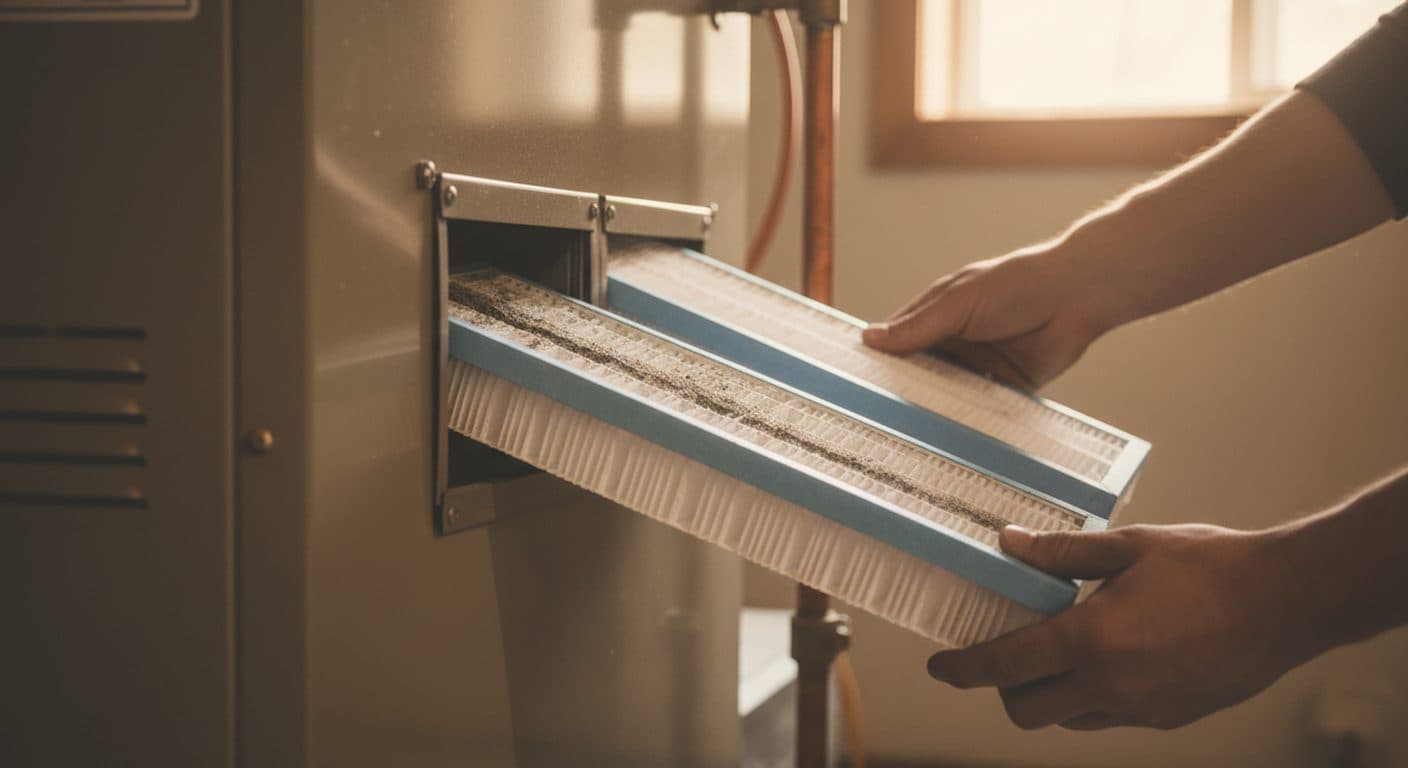
How often to change furnace filter is one of those questions nobody thinks about until the heat kicks on for the first time in fall. Then you realize you cannot remember the last time you changed it.
Here is the short answer. ENERGY STAR, the federal energy efficiency program, recommends checking your filter every month and changing a standard filter at least every three months. The rest of this guide covers why it matters, what makes your home need it more often and how to pick the right filter so you are not paying for one that works against your system.
The one thing to check: the light test
1. Turn the thermostat off so the blower is not running.
2. Slide the filter out. It is usually in a slot where the big return duct meets the furnace, or behind a grille on a wall or ceiling.
3. Hold it up to a lamp or a window. If you cannot see light through it, it is due.
4. While it is out, write down the size printed on the frame, for example 16x25x1. Snap a photo of it with your phone. Now the next one is easy to buy.
How Often to Change Furnace Filter: The Quick Answer
The biggest thing that changes the answer is how thick your filter is. A thicker filter has more material to hold dust, so it lasts longer. These are typical starting points. The schedule printed on your filter's package wins, and the light test tells you the truth for your home.
Typical schedules only. They vary by brand, home and season. Check the label on your filter and do the light test.
Why a Dirty Filter Makes Your Furnace Work Harder
Your furnace pulls air from your rooms, pushes it through the filter, heats it and sends it back out. When the filter clogs, the blower has to fight to pull air through it. Less air moves across the hot part of the furnace, so the heat has nowhere to go.
Furnaces have a safety switch for exactly this. When the inside gets too hot, the switch shuts the burners off. The furnace cools down, starts again, overheats again and shuts off again. That on and off pattern is called short cycling. Here is what it looks like from your couch:
· The furnace runs for a few minutes, stops, then starts again soon after
· Weak airflow from the vents
· Some rooms never get warm, often the ones farthest from the furnace
· Higher gas or electric bills for the same thermostat setting
· More dust on furniture than usual
Running that way for months is hard on the blower motor and the other parts that get switched on and off far more than they were built for. A new filter is the cheapest repair your furnace will ever get. If one room in your home is always the odd one out even with a clean filter, our post on why one room is always hotter walks through the other causes.
What Changes How Often to Change Furnace Filter
Pets
Fur and dander load a filter fast. With a dog or cat that sheds, check every month and expect to change a 1 inch filter more often than the package says.
Allergies or asthma
A fresh filter catches more of what bothers you. Many families with allergies change more often during the months the system runs most.
Construction or renovation dust
Sanding drywall, cutting tile or tearing out a floor can clog a filter in days. Check it every week while the work is going on and put a fresh one in when the dust settles.
A cold snap or a heat wave
The filter fills based on how much air moves through it, not the calendar. A week of the furnace running nonstop does more than a mild month.
Filter thickness
A 4 or 5 inch filter has far more surface to hold dust than a 1 inch one. That is why it lasts so much longer.
Smoking, candles or a wood stove
Smoke and soot fill a filter faster. Check it more often.
What the MERV Number Means, and Why Higher Is Not Always Better
MERV stands for Minimum Efficiency Reporting Value. It is a rating from 1 to 16 that comes from an industry testing standard. The higher the number, the smaller the particles the filter can catch.
Low MERV, roughly 1 to 4
Thin fiberglass filters. They stop big dust and hair from reaching the furnace but do little for the air you breathe.
Middle, around MERV 8
The common pleated filter. Catches dust, lint and pollen. A good fit for most homes.
Higher, MERV 11 to 13
Catches finer particles like pet dander and some smoke. Worth a look for homes with allergies, if the system can push air through it.
That last part is the catch. A higher rated filter is denser. On a system built around a thin 1 inch slot, a very dense filter can cut airflow the same way a dirty one does, and you are back to short cycling. A 4 or 5 inch media filter gets around this. It spreads the same fine filtering over much more surface, so air moves through easily. You cannot just push a thick filter into a 1 inch slot, though. It needs its own cabinet, which an HVAC pro can add.
One more thing at the store: some brands use their own scales, like MPR or FPR, instead of MERV. They are not the same numbers. Look for the MERV rating on the package so you can compare fairly.
How to Change a Furnace Filter in Five Minutes
1. Turn the thermostat off.
2. Find the filter slot. Look where the large return duct meets the furnace, or for a hinged grille on a wall or ceiling.
3. Slide the old filter out and note which way its arrow pointed.
4. Slide the new one in with the arrow pointing toward the furnace. The arrow shows which way the air flows.
5. Write today's date on the frame in marker.
6. Turn the thermostat back on and set a phone reminder for your next check.
Buy two or three at a time in your size. When the next one is already sitting next to the furnace, you will actually change it.
When a New Filter Does Not Fix It
A fresh filter fixes a lot, but not everything. Book an HVAC pro if any of these keep happening after you change it:
· The furnace still turns on and off every few minutes
· The vents blow cold air while the heat is set to come on
· New grinding, squealing or banging sounds
· A burning smell that does not fade after the first few hours of the season
· Water around the base of the furnace
Safety first
If your carbon monoxide alarm goes off or you smell gas, do not troubleshoot. Get everyone out of the house and call 911 or your gas company from outside.
Fall is also the right time for a yearly furnace tune-up, before everyone else calls at the first freeze. Our HVAC services page explains how to book one. For a sense of what common repairs typically cost, see our HVAC repair and replacement cost guide. If the heat is already out on a cold night, start with our emergency HVAC guide.
Whoever you hire, ask them to look at the system in person and put the price in writing before work starts. Ask for their license and proof of insurance too.
Find HVAC Help Near You
Book an independent local HVAC company for a tune-up, a repair or a check on whether your system can take a better filter.
Furnace Filter Questions
Can I run my furnace without a filter for a day or two?
Try not to. Without a filter, dust and pet hair go straight into the blower and the coil above the furnace, where they are much harder and more expensive to clean than a filter is to replace. If you pulled the old filter and do not have a new one yet, put the old one back in until you do.
Which way does the arrow on a furnace filter go?
Toward the furnace. The arrow shows the direction the air moves. Air is pulled from your rooms through the return duct, through the filter and into the furnace, so the arrow should point away from the return duct and at the furnace.
Do I need to change the filter in summer too?
Yes, if you have central air. Most central air systems use the same blower and the same filter as the furnace, so the filter keeps loading up all year. Summer and winter are the two seasons to check it most often.
Is a more expensive filter always better?
No. A higher MERV filter catches smaller particles but it is also denser, so air has a harder time getting through. On some systems built around a thin 1 inch filter, a very dense one can choke the airflow the same way a dirty filter does. If you want a high MERV filter, ask an HVAC pro whether your system can handle it.
Can I wash and reuse my furnace filter?
Only if it was sold as washable or permanent. Standard pleated and fiberglass filters are throwaway. Washing them damages the material and a damp filter can grow mold. If you do have a washable one, let it dry completely before it goes back in.
What if the size is not printed on my filter?
Measure the length, width and thickness with a tape measure. Filters are sold by a rounded size, so a filter that measures about 15 1/2 by 24 1/2 inches is usually sold as a 16 by 25. Take the measurements or the old filter to the store to be sure, then write the size on the furnace in marker so you never have to measure again.
Contractor Palace
Furnace still acting up? Book a local HVAC pro.
Tell us what your furnace is doing and we will match you with an independent local HVAC company that serves your area.