
Sioux Falls Roofing: Where a 130-Degree Annual Temperature Range Meets South Dakota Hail Country
Sioux Falls is the economic capital of South Dakota and the seat of Minnehaha County, sitting at the eastern edge of the Great Plains where weather systems from the north, south and west converge without a mountain range or significant terrain feature to slow them down. The result is one of the most climatically demanding roofing environments in North America. Winter temperatures routinely drop to minus 20 or minus 30 degrees Fahrenheit while summer highs regularly reach 95 to 100 degrees, creating an annual temperature swing of 130 degrees or more that subjects roofing materials to expansion and contraction stresses that would destroy a poorly installed system within a decade.
Spring and early summer in Minnehaha County bring a different category of threat. South Dakota consistently ranks in the top ten states nationally for hail damage per capita, and Sioux Falls sits directly in the storm corridor that produces the largest share of that damage. Hailstorms capable of stripping granules from asphalt shingles, cracking tile and denting metal flashing occur multiple times each season. A single significant hail event can generate hundreds of insurance claims across the Sioux Falls metro simultaneously, which is why homeowners who schedule a professional inspection within days of a storm preserve their strongest documentation window before weathering and adjuster backlogs narrow the claim scope.
The Sioux Falls economy has grown rapidly over the past two decades. Major employers including Sanford Health, one of the largest rural health systems in the United States, and the regional banking operations of Wells Fargo and other institutions that established large South Dakota footprints after state lawmakers removed interest rate ceilings in the early 1980s, have anchored a professional and financial services workforce that has driven sustained residential construction. New subdivisions in Brandon, Tea and Harrisburg have added thousands of homes to the Sioux Falls metro, and that new construction is now entering its first significant roofing replacement and warranty claim cycle alongside the older neighborhoods closer to downtown where roofs are at or past their original design lifespan.
Sioux Falls Has One of the Most Demanding Roofing Climates in North America
The annual temperature swing in Sioux Falls, from roughly minus 30 degrees Fahrenheit in January to 100 degrees in July, spans approximately 130 degrees. That thermal range subjects every component of a roofing system to continuous expansion and contraction stress that accelerates joint failure, sealant cracking and shingle aging beyond what manufacturers' warranty terms assume in milder markets. Combined with frequent freeze-thaw cycling in early spring and late fall, heavy snowfall, ice storm events and spring hailstorms, Sioux Falls imposes a roofing load cycle that demands both better materials and more careful installation than most comparable-sized cities require.
Sioux Falls Hail and Ice Storm Roofing: What to Know Before You File a Claim
Hail damage in Sioux Falls follows a predictable but unpredictable pattern. The season runs from late April through early September, with the highest frequency in May, June and July. Hailstones as small as three-quarters of an inch cause granule displacement on standard asphalt shingles, which reduces the shingle's remaining UV protection and shortens service life even when the damage is not visible to an untrained observer from the ground. Stones above one inch cause functional damage including bruising of the asphalt mat, cracking and edge damage that constitutes a covered insurance event under most standard South Dakota homeowner policies.
After a significant Sioux Falls hailstorm, out-of-state storm-chasing contractors arrive in Minnehaha County within days. Some of these contractors do legitimate work; many do not maintain a permanent South Dakota presence, carry insufficient insurance and will not be reachable when a warranty issue appears two years later. Contractor Palace works exclusively with roofing companies that maintain a permanent presence in the Sioux Falls metro with verifiable local project history, so the contractor who installs your roof is the same contractor whose phone number still works when the warranty matters.
Ice storms are the winter companion to hail season in Sioux Falls. While the city receives substantial snowfall, it is the freezing rain events that create the most acute roofing damage. Ice loading adds hundreds of pounds of dead weight to gutters and roof framing that was not designed for that load. Freeze-thaw cycling, which occurs repeatedly each winter and even more aggressively in the shoulder seasons of October and March, opens micro-cracks in sealants, shingle edges and flashing joints that allow water infiltration long after the ice has melted. Interior water damage from this infiltration often does not appear as a visible ceiling stain until the damage to the structural roof deck is already significant.
Why Use Contractor Palace for Roofing in Sioux Falls SD
South Dakota hail damage documentation specialists
Minnehaha County's consistent spring and summer hail seasons make insurance claim documentation one of the most critical skills a Sioux Falls roofing contractor can have. Contractor Palace verifies that our matched roofers understand how to identify and photograph functional hail damage on asphalt shingles, metal flashing and gutters in a format that supports a full replacement settlement rather than a partial repair offer. The documentation produced in the first days after a storm is the foundation of the entire insurance claim.
Extreme climate material expertise
Not every roofing product performs equally across a 130-degree annual temperature range. Sioux Falls contractors in our network specify products rated for the full severity of South Dakota's climate, including Class 4 impact-resistant architectural shingles, high-temperature-rated underlayments and ice and water shield coverage at all eaves, valleys and penetrations. Cutting corners on materials in a Sioux Falls winter produces failures within a few seasons rather than the 25 to 30 year lifespan a properly installed system delivers.
Ice storm and freeze-thaw cycle experience
South Dakota's freeze-thaw cycling is among the most aggressive in the continental United States. Sioux Falls roofing contractors in our network understand the damage patterns that ice storms and repeated freeze-thaw cycling produce, know how to document that damage for insurance claims and install the ice and water shield protection that prevents future infiltration. A contractor who replaces damaged shingles without addressing the underlying ice infiltration path leaves the same failure point in place for the next winter.
Permanent local contractors, no storm chasers
Sioux Falls's frequent hailstorms attract a wave of out-of-state contractors after every significant event. Contractor Palace works exclusively with roofing companies that maintain a permanent Minnehaha County or Sioux Falls metro presence with established local project history. Our matched contractors are operating in Sioux Falls before the storm and will be reachable when the warranty issue arises two or three winters from now.
How to Choose a Roofing Contractor in Sioux Falls South Dakota
Understand South Dakota's licensing situation
South Dakota does not require a statewide contractor license for roofing work, which means there is no central state registry to check the way you would in Arizona or Florida. The burden shifts to the local level. The City of Sioux Falls requires contractors operating within city limits to hold a current city contractor registration and carry general liability and workers compensation insurance. Before hiring any Sioux Falls roofing contractor, ask for their Sioux Falls contractor registration number, a certificate of general liability insurance and proof of workers compensation coverage. A contractor without workers comp leaves you personally liable if a worker is injured on your property.
Verify local permanence after a hail event
Storm chasers descend on Minnehaha County within days of a significant hail event. Ask any contractor approaching you after a storm for a permanent Sioux Falls-area physical address, a Google Business profile that predates the most recent storm and references from local projects completed in non-storm years. A roofing company that arrived in Sioux Falls with the storm will not be available when a flashing failure causes interior water damage two winters from now. Check the South Dakota Secretary of State business registry to verify the company has an established South Dakota filing date.
Require full ice and water shield coverage
Building code in the Sioux Falls climate zone requires ice and water shield at roof eaves and valleys, but the minimum code is not the same as the correct installation for South Dakota's climate severity. Ask your roofing contractor specifically about ice and water shield coverage at all penetrations, skylights and chimney bases in addition to eaves and valleys. The freeze-thaw cycling in Sioux Falls puts every sealant joint and flashing edge under cyclic stress, and the ice and water shield is the last line of defense when that stress creates an opening.
Ask about hail-resistant shingle options before signing
Replacing a hail-damaged roof with standard architectural shingles in Sioux Falls is a reasonable choice but not necessarily the financially optimal one. Class 4 impact-resistant shingles, which use a polymer-reinforced mat to resist hail impact up to two inches in diameter, are available at a moderate upfront premium. South Dakota insurers often offer premium discounts for Class 4 equipped homes, and given Minnehaha County's documented hail frequency, those annual savings typically offset the upgrade cost within several policy years. Ask your matched contractor for a comparison quote before making your material selection.
Roofing Contractors Serving Sioux Falls and the Surrounding Area
Contractor Palace matches Sioux Falls homeowners and property managers with verified roofing contractors who serve Minnehaha County and the full surrounding metro. The Sioux Falls metro has expanded rapidly to the south and southeast, with Brandon, Tea, Harrisburg and Renner absorbing significant residential construction over the past decade. Those newer communities are built on the same exposed Great Plains terrain as Sioux Falls proper and face identical hail and ice storm exposure. Contractor Palace's matched roofers serve the full metro footprint, not just the core Sioux Falls zip codes.
The I-90 corridor east of Sioux Falls connects communities like Crooks and Baltic that have grown as bedroom suburbs for Minnehaha County workers. Further out, Brookings to the north, Mitchell to the west and Watertown to the northeast represent regional markets where Sioux Falls-based roofing contractors regularly work on both residential and commercial projects. For properties in Lincoln County communities including Tea, Harrisburg and Canton, our matched contractors are familiar with the Lincoln County permit process and building department requirements that differ from Minnehaha County procedures.
What Is a Roofing System and How Does It Perform in South Dakota's Climate
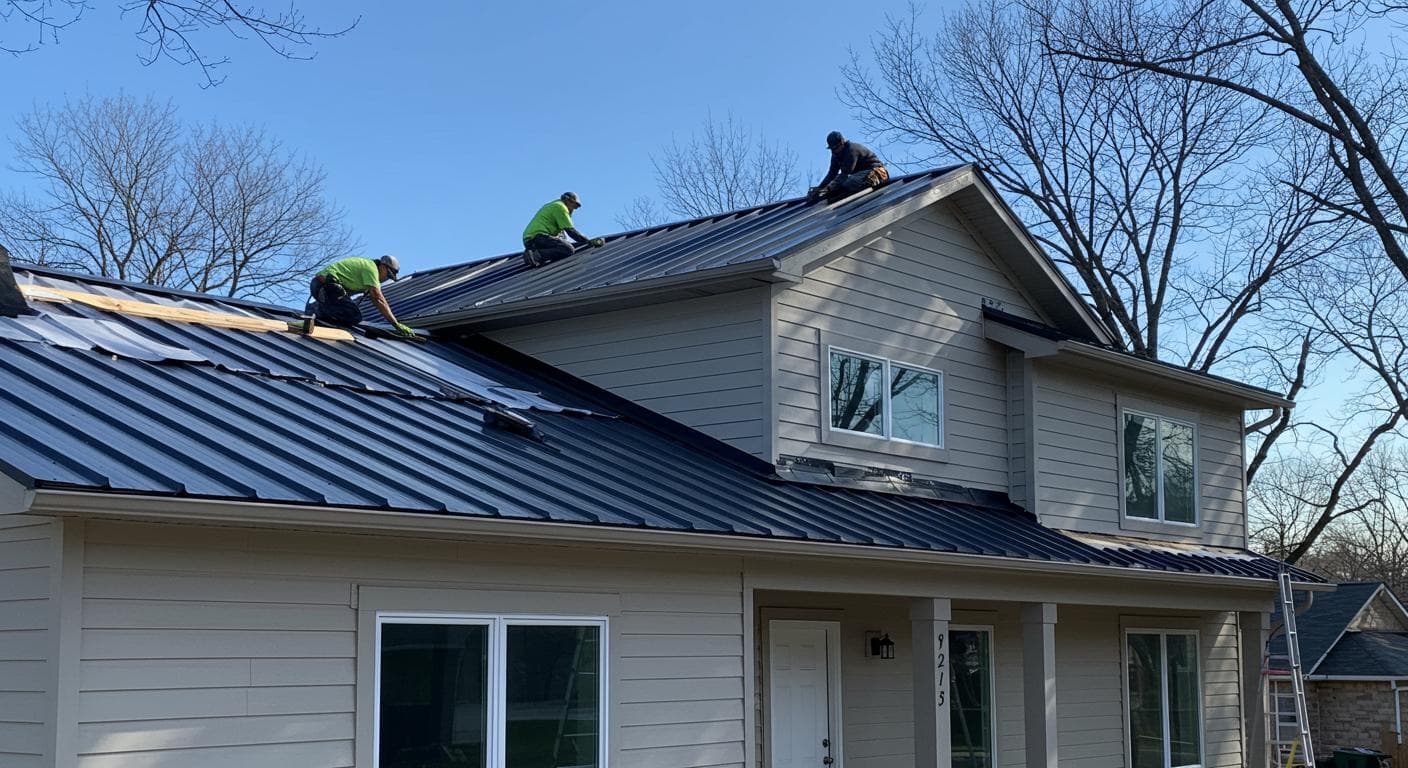
A residential roofing system in Sioux Falls is not simply the shingles visible from the street. It is a layered assembly starting with the structural roof deck, followed by a self-adhering ice and water shield membrane at all eaves, valleys and roof penetrations, a synthetic underlayment across the full field of the roof and then the primary weathering surface. In Minnehaha County, that weathering surface is most commonly architectural asphalt shingles, though metal roofing has grown significantly in market share as homeowners weigh the long-term economics against repeated hail claims on asphalt systems.
South Dakota's climate imposes unique demands on every layer of this assembly. The ice and water shield at the eaves is not optional in the Sioux Falls climate zone. Freeze-thaw cycling creates ice dam conditions when heat from the living space escapes into the attic and warms the roof deck, causing snow to melt at the mid-slope and ridge and refreeze at the cold eave edge. The ice dam then forces meltwater backward under the lowest course of shingles. Ice and water shield is the only roofing layer designed to resist this lateral infiltration; standard felt underlayment is not. Similarly, the attic ventilation system controls the temperature differential that drives ice dam formation and, in summer, the heat buildup that accelerates shingle aging from below. A roofing contractor who replaces shingles without inspecting the ventilation system leaves the biggest performance variable unaddressed.
Asphalt shingles come in three categories that Sioux Falls homeowners encounter regularly. Three-tab shingles are no longer installed on new or replacement work in most of South Dakota because of their poor wind and impact resistance. Architectural dimensional shingles are the standard replacement product, carrying design wind ratings of 110 to 130 miles per hour and a meaningful improvement over three-tab in hail resistance. Class 4 impact-resistant architectural shingles use a polymer-reinforced mat that passes the UL 2218 Class 4 test, resisting hail impact up to two inches in diameter. For a market like Sioux Falls where significant hail is a predictable annual event, the Class 4 upgrade is worth serious evaluation against the insurance premium savings it often unlocks.
Types of Roofing Systems for Sioux Falls South Dakota Homes
Standard architectural asphalt shingles
The most common roofing material in Sioux Falls by a wide margin. Modern architectural shingles carry 30 to 50 year material warranties and perform reliably across South Dakota's climate range when installed with proper ice and water shield, ventilation and flashing. Expect a 20 to 25 year realistic service life under Sioux Falls conditions rather than the full warranty term, as the combination of UV exposure, severe freeze-thaw cycling and periodic hail impact degrades asphalt faster than manufacturers' test conditions assume. The lower upfront cost compared to Class 4 or metal makes standard architectural shingles the practical choice for most Minnehaha County homeowners who are replacing a storm-damaged roof on an insurance claim.
Class 4 impact-resistant shingles
The most financially sound upgrade for Sioux Falls homeowners replacing a roof who intend to own the property long-term. Class 4 rated shingles, available from major manufacturers including Owens Corning, GAF and CertainTeed, use a fiberglass or polymer mat that passes the UL 2218 Class 4 impact test. South Dakota insurers offer homeowners a premium discount for Class 4 equipped homes, and given Minnehaha County's documented hail frequency, those annual savings compound meaningfully over the policy period. A Class 4 system that survives hail events that would total a standard asphalt roof also avoids the deductible exposure and claim history effects that repeat hail claims create.
Standing seam metal roofing
A 40 to 70 year roofing system and the correct long-term investment for Sioux Falls homeowners who want a roof that handles every South Dakota weather extreme without ongoing replacement cycles. Metal is essentially immune to hail damage that would destroy asphalt shingles, handles the full range of South Dakota's freeze-thaw cycling without the granule loss and mat degradation that accumulates on asphalt and reflects summer heat to reduce attic temperature. The upfront cost is significantly higher than asphalt, but the lifecycle economics favor metal for homeowners planning to own the property for 20 or more years, particularly when Class 4 insurance savings are factored into the asphalt comparison.
Ice and water shield and siding coordination
Sioux Falls hailstorms rarely damage just the roof. Siding takes direct hail impact from the same storm that strips granules from shingles, and a complete storm restoration often involves coordinating roofing and siding work through a single contractor or a coordinated pair of contractors. Contractor Palace matches Sioux Falls homeowners with roofing contractors who can assess total exterior damage, document both the roofing and siding scope for the insurance carrier and coordinate or refer the full exterior replacement so both claims are filed correctly and the work is sequenced to prevent re-damage during construction.
Frequently Asked Questions
How much does a roof replacement cost in Sioux Falls SD?
A standard architectural asphalt shingle roof replacement for a 1,500 square foot Sioux Falls home typically runs $7,000 to $14,000 including materials, labor, ice and water shield at all eaves and valleys, a decking replacement allowance and debris disposal. South Dakota roofing prices run slightly below the national average, reflecting regional labor costs, but material costs for quality products are consistent across the country. Class 4 impact-resistant shingles add $2,000 to $3,500 over standard asphalt, and that difference is frequently offset by South Dakota insurer premium discounts over several policy years. Standing seam metal roofing in Sioux Falls runs $16,000 to $36,000 depending on roof complexity and pitch. Ice and water shield installation at eaves and valleys on a home that was previously under-protected runs $800 to $2,500 depending on the linear footage involved.
Does homeowner insurance cover hail damage in Sioux Falls?
Most standard homeowner insurance policies in South Dakota cover hail damage to roofing systems. The outcome of the claim depends heavily on how the damage is documented. Insurance adjusters distinguish between functional storm damage, meaning damage that reduces the roof's remaining service life or protective capability, and pre-existing deterioration or cosmetic surface marks. Functional hail damage includes granule displacement consistent with impact patterns, bruising or cracking of the asphalt mat visible on the underside of the shingle and denting of metal flashing, vents and gutter systems. A Sioux Falls roofing contractor experienced with South Dakota insurance claims documents this damage photographically and in a written scope of loss within days of the storm, when the evidence is clearest. Filing promptly after a Minnehaha County hail event is critical to preserving the strongest possible documentation window.
What South Dakota licensing is required for roofing contractors?
South Dakota does not require a statewide specialty license for roofing contractors, which means there is no state registry to check the way homeowners can verify a license in states with mandatory contractor licensing. The licensing burden falls at the local level. The City of Sioux Falls requires contractors operating within city limits to hold a current city contractor registration and pull the required building permit for roofing replacement projects. Any legitimate Sioux Falls roofing contractor should carry a minimum of $1 million in general liability insurance and active workers compensation insurance covering all employees on site. Before hiring any contractor, request certificates of insurance directly from the contractor's insurance agent so you can verify the coverage is current. Contractor Palace verifies city registration and insurance currency for every roofer in our Sioux Falls network before you connect with them.
How do ice storms damage roofing differently than snow in Sioux Falls?
Snow is relatively light per inch and typically slides or melts without causing structural consequences beyond brief load on framing during heavy accumulation events. Freezing rain is a fundamentally different threat. Ice from a freezing rain event forms a dense solid sheet that bonds to shingles, gutters and flashing and adds hundreds of pounds of dead load to structures not designed for that weight. Gutter systems attached to fascia with standard fastening can be torn off entirely under ice loading. Freeze-thaw cycling that follows a Sioux Falls ice storm opens micro-cracks in shingle edges, sealant joints and flashing that allow water infiltration during the next rain event, often showing up as ceiling stains or attic moisture weeks after the original storm. Ice storm damage is a covered peril under most South Dakota homeowner policies and should be documented and claimed like any other storm event.
Need a roofing contractor in Sioux Falls? Get matched free.
Describe your roofing project or storm damage. We match you with a verified Sioux Falls roofer who handles the insurance process and knows Minnehaha County's hail and ice storm history.
Get my free Sioux Falls roofing quotearrow_forward