
Garage Builder near me. Garage Construction, local.
New detached garage construction, attached additions and garage conversions across Ohio. Our experienced crews handle everything from permits and foundation to framing, siding, roofing and door installation, and we're building the same experienced network across Colorado's Front Range.
What is garage construction?
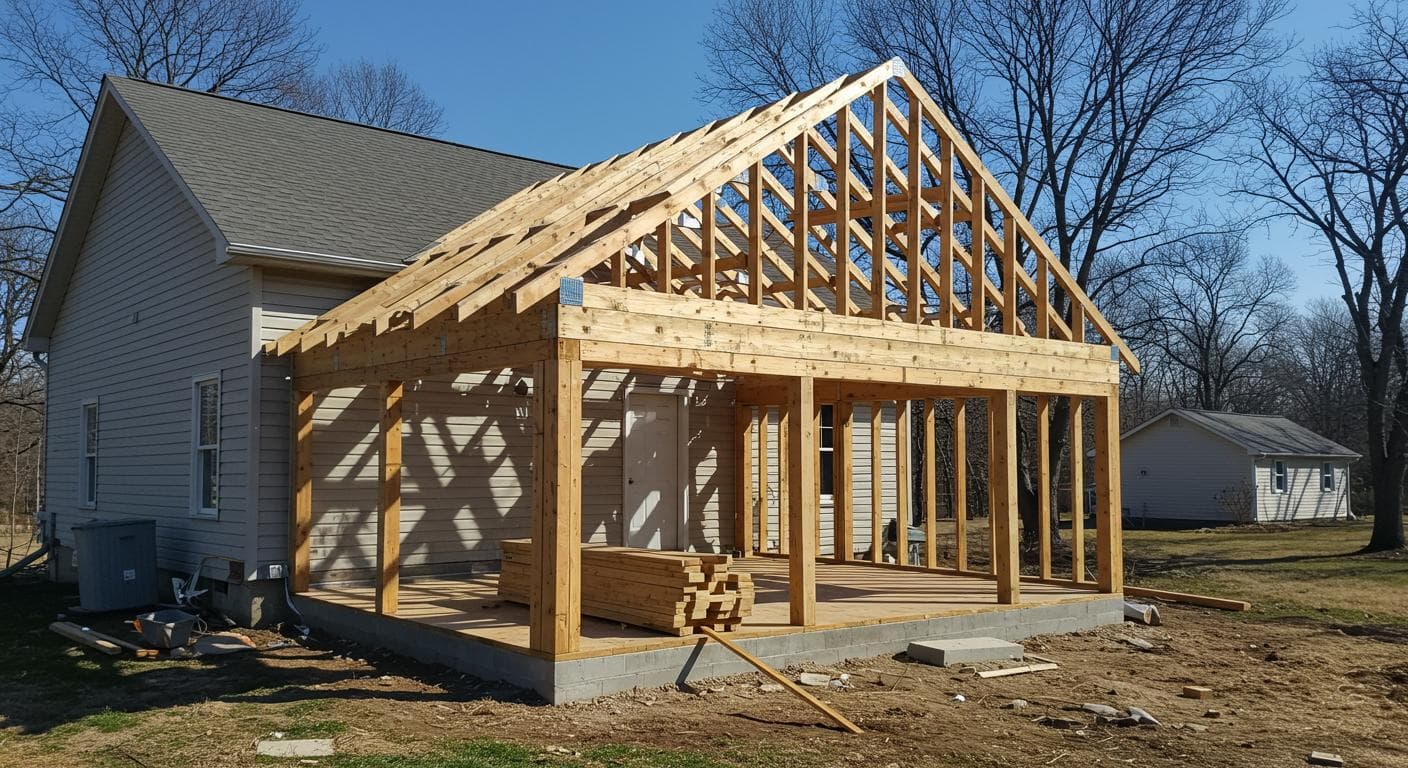
Garage construction in Ohio covers new detached garages, attached garage additions, carports and garage-to-living-space conversions. A new garage is one of the highest-ROI additions an Ohio homeowner can make, typically recouping 60-80% of cost at resale while providing daily functional value through weather protection, storage and workspace.
Ohio garage construction requires a building permit and site plan approval through your local municipality. The process involves site preparation, concrete slab with frost-depth footings (minimum 36 inches in Ohio to prevent frost heave), wood or steel framing, roofing, siding, garage door installation and electrical rough-in for lighting and outlets.
Ohio code requirements for garages include proper ventilation, ground fault circuit interrupter (GFCI) outlets, minimum headroom clearance and fire separation requirements for attached garages (typically 5/8-inch Type X drywall on the house side). Attached garage additions also require careful structural integration with the existing home foundation and framing.
Detached garages in Ohio are popular for their flexibility, they can be built to any size, include second-floor storage or living space and are positioned away from the house for workshop use.
What homeowners should know.
Detached Garage Construction in Ohio
Building a detached garage in Ohio is a significant project with real variability in cost, timeline and structural requirements depending on size, site conditions and finish level. A single-car detached garage (12x24 ft) starts around $25,000 to $40,000 fully built with standard materials, electrical service and a concrete floor. A two-car garage (24x24 ft) runs $40,000 to $70,000 at mid-range finishes. Three-car or larger structures and garages with living space above (carriage house style) run $70,000 to $150,000 and above.
These ranges assume conventional stick-frame construction. Prefabricated metal buildings and post-frame (pole barn) construction offer lower cost per square foot but come with different code considerations in Ohio municipalities.
Foundation and Floor Requirements
Most Ohio municipalities require a footing and foundation for permanent detached garages, not just a floating slab. Footing depth must reach below the frost line: 36 inches in central Ohio and 42 inches in northern Ohio. A monolithic slab with thickened edges is an alternative approach accepted in some jurisdictions. Confirm with your local building department before construction begins.
Concrete floors for garages are typically 4 inches thick with wire mesh or fiber reinforcement and a 3,500 PSI mix. If the garage will see heavy vehicle loads or a vehicle lift, 5 to 6 inches with rebar is appropriate.
Permits and Zoning
A building permit is required for any permanent structure in Ohio. In addition, zoning rules govern setbacks from property lines, maximum square footage relative to lot size and whether the structure can include living space. Most Ohio municipalities limit accessory structures (detached garages) to a certain percentage of the main dwelling's footprint. Verify zoning compliance before finalizing your design.
HOA restrictions, where applicable, often add requirements around exterior materials, roof pitch and door style. Review HOA documents before starting the design process.
Structural and Finish Decisions
Roof pitch affects both aesthetics and storage capacity above the plate line. A steeper pitch (10/12 or 12/12) allows full loft storage. Lower pitches (4/12 or 6/12) are more common on standard garages and match most Ohio home styles. Attic trusses allow usable floor space above the main level at relatively modest additional cost.
Insulation and heating: an insulated garage with a heater dramatically extends its usability in Ohio winters. Blown-in insulation in walls and the attic plane, combined with an electric or gas unit heater, adds $2,000 to $5,000 to the project cost and pays back in usability every winter.
Choosing a Contractor
Ask for references from similar-scale garage projects completed in your Ohio county within the last 2 to 3 years. Verify that the contractor pulls permits themselves and is familiar with your local building department's inspection process. A single general contractor who subcontracts concrete, framing, electrical and roofing is the most efficient approach for a full garage build. Avoid separate-trade management unless you have project management experience.
### Detached vs. Attached Garage: What Ohio Homeowners Need to Know Before Choosing
This is the first decision in any Ohio garage project and the right answer depends on your lot, your goals and your local zoning rules rather than a universal preference.
Detached garages are more flexible in design, can be positioned to maximize remaining yard space and avoid the fire separation requirements that attached garages trigger under Ohio Residential Code. A detached structure can be built at any scale from a simple one-car shelter to a workshop with a finished second floor. They are generally simpler to permit because they do not require structural integration with the existing home. The tradeoff: you walk outside to get from the house to the garage, which Ohio winters make relevant for 4 to 5 months per year.
Attached garages add directly to the home's footprint and provide interior access, which Ohio homeowners consistently cite as the primary functional advantage. An attached garage makes groceries, school pickups and winter departures significantly more convenient. Code requirements are more demanding: the wall and ceiling assembly connecting the garage to living space must be 5/8-inch Type X drywall (fire separation), any door between the garage and house must be a solid-core or steel fire-rated door with self-closing hardware and the floor of the attached garage must be sloped to drain toward the exterior. These requirements add cost but also represent genuine fire safety infrastructure.
Cost difference between the two for an equivalent two-car structure in Ohio: attached garages typically run 20 to 35 percent higher than detached construction of the same size due to structural integration complexity, foundation work that ties into the existing home and the fire separation requirements.
For lots with limited rear yard depth, an attached addition may be the only realistic option. For lots with generous side or rear yard space, a detached garage preserves more flexible outdoor space while keeping the garage accessible and useful.
### Ohio Garage Construction Cost: What Drives the Price
The price range for Ohio garage construction is wide, 15,000 to 60,000 dollars or more and understanding the variables explains why. This is not vague contractor pricing. Each factor below has a real cost impact.
Foundation type: a standard monolithic concrete slab with thickened edges appropriate for a simple detached garage on flat land costs 5,000 to 9,000 dollars for a 24x24 foot footprint. A full perimeter foundation with stemwalls (required by many Ohio municipalities for permanent structures or required by soil conditions) adds 3,000 to 6,000 dollars. Frost-depth footings, required everywhere in Ohio at a minimum of 36 inches in central Ohio and 42 inches in the northern part of the state, are included in any proper Ohio foundation quote. A contractor who quotes without specifying footing depth is either omitting them (which leads to heaving and cracking) or assuming you will not ask.
Building size and height: a 24x24 two-car garage is the most common Ohio build. Standard eave height is 8 feet. Raising to a 10-foot eave to accommodate taller trucks, RVs or a car lift adds 500 to 1,500 dollars in framing materials. A 12-foot eave for a tandem bay or three-car structure adds more. The garage door opening height matters: a standard 7-foot door fits most cars and light trucks. A 9 or 10-foot door for tall trucks or SUVs is increasingly requested and adds 300 to 600 dollars per opening.
Framing method: conventional stick-frame (lumber framing) is standard for Ohio residential garages and matches the construction method of the house, which matters for attached additions. Post-frame (pole barn construction) is faster and sometimes less expensive per square foot for large detached structures but is not accepted in all Ohio municipalities for residential garage use. Confirm zoning acceptance before pricing a post-frame build.
Roofing: asphalt shingles matching the house are standard. Metal roofing on a garage adds cost but is virtually maintenance-free and lasts significantly longer, worth considering for a structure expected to last 40 to 50 years.
Insulation and heating: an uninsulated garage is functional but cold in Ohio winters. Insulating the walls (R-13 minimum) and ceiling (R-30 minimum) plus adding a gas unit heater (2,500 to 4,500 BTU range, 800 to 1,800 dollars installed including gas line extension) transforms the space into a year-round workshop. This upgrade runs 3,000 to 6,000 dollars added to the base build.
Electrical: standard is a subpanel from the house with circuits for lighting, outlets and a garage door opener. EV charging requires a 240V 50-amp dedicated circuit. Workshop tools (table saw, air compressor) may need 240V circuits as well. Plan electrical during design, adding circuits after construction is significantly more expensive.
### Ohio Garage Zoning and Permit Requirements in Detail
Every permanent detached garage in Ohio requires a building permit and must comply with local zoning ordinances. The permit process in most Ohio cities involves a building permit application with a site plan showing the structure location relative to property lines and the house.
Setback requirements are the most common reason for site plan revision. Ohio municipalities typically require a minimum setback of 5 to 10 feet from side and rear property lines for accessory structures. Suburban zoning in Columbus suburbs like Westerville and Dublin may require 10 to 15-foot setbacks. In Cleveland suburb cities like Strongsville and Berea, requirements vary by zone district. Your contractor should verify setbacks before finalizing the site plan.
Maximum accessory structure size: many Ohio municipalities limit detached garages to a square footage percentage of the main dwelling. A typical rule is that the accessory structure cannot exceed 50 to 75 percent of the dwelling's floor area. A 1,500 square foot house in a jurisdiction with this rule may be limited to a 750 to 1,125 square foot garage.
HOA rules apply in addition to municipal codes and often add requirements around exterior appearance (matching siding, shingles, door style) and size. Review your CC&Rs before finalizing the design.
Timeline: permit approval typically takes 3 to 8 weeks in Ohio municipalities. Some rural counties process faster. Columbus, Cleveland and Cincinnati city permit offices run longer during peak construction season (spring and summer).
### Step-by-Step: What the Ohio Garage Build Process Looks Like
Site assessment and design: contractor visits the property to evaluate grade, drainage, existing utilities (call 811 for underground utility locates before any excavation), setbacks and HOA or neighborhood constraints. This visit produces a preliminary site plan and structural design.
Permitting: contractor submits building permit application with site plan, structural drawings and foundation details. Fee varies by municipality, typically 200 to 800 dollars for a residential garage.
Excavation and foundation: site is graded, forms are set and concrete is poured. Frost-depth footings cure a minimum of 7 days before framing begins. Ohio's spring weather means rain delays are common in the concrete phase.
Framing: walls, roof structure and sheathing are completed in 3 to 5 days for a standard two-car detached garage. Inspections occur at framing stage in most Ohio jurisdictions before walls are sheeted.
Mechanical and rough-in: electrical rough-in is completed, plumbing (if a utility sink is included) is stubbed and any in-floor heat is run before the final floor is poured.
Exterior and finishing: siding, roofing, soffit and fascia, windows and doors. Garage door and opener installation is typically last. Interior drywall (required in attached garages and optional in detached) is finished after mechanical inspections.
Final inspection and certificate of occupancy: final inspection confirms code compliance. CO is issued and your insurance can be updated to reflect the new structure.
### Common Mistakes in Ohio Garage Construction Projects
Underspecifying the electrical load. Homeowners who later want an EV charger, welder or compressor return to discover a too-small subpanel or no available breaker slots. Planning for future use during construction is inexpensive. Upgrading a completed garage subpanel later costs 1,500 to 3,500 dollars.
Skipping the site drainage assessment. Ohio's clay soils shed water toward whatever low point exists on the lot. A garage sited in a low spot without proper grading and drainage built into the foundation becomes a water problem that damages the slab and framing over time.
Choosing a contractor based on speed and price without verifying permit history. A contractor who builds fast, cheap garages without pulling permits is creating an unpermitted structure that will surface as a legal and financial problem when you refinance or sell the property.
### Mini FAQ
**Does a new garage increase my Ohio property tax?** Yes. A permitted permanent structure adds to your property's assessed value. The exact increase depends on your county auditor's assessment process and the structure value. Consult your county auditor's office before starting if this is a significant concern.
**Can I convert my existing one-car garage to a two-car garage in Ohio?** Typically yes, if your lot setbacks allow the expansion and zoning permits the larger footprint. This involves demolishing one wall, extending the foundation and framing, adjusting the roofline and adding a second door opening. Cost runs 15,000 to 30,000 dollars depending on scope.
**How long does a typical Ohio two-car garage build take from permit to completion?** Allow 10 to 16 weeks total: 3 to 8 weeks for permit approval, 4 to 8 weeks of construction. Weather delays in Ohio spring and winter can extend the construction phase. Projects started in late summer or early fall tend to complete before winter weather complicates concrete work.
**Do I need a survey before building a garage in Ohio?** A survey is strongly advisable if you are unsure of your property line locations. Garages built too close to or across a property line must be demolished or relocated at the owner's expense. Many Ohio homeowners discover their lot lines are not where they assumed when a neighbor or surveyor checks.
Colorado Garages: Expansive Soil and the Front Range
A detached or attached garage slab on Colorado's Front Range faces the same expansive clay soil issue that affects driveways and basement floors in the region, the clay under the slab swells and shrinks as its moisture content changes, which can heave and crack a garage floor that was built the way an Ohio garage slab typically is. Front Range garage builders commonly address this with proper subgrade preparation, sometimes replacing expansive clay with compacted structural fill under the slab, and floor slabs are occasionally kept structurally independent of the foundation stem walls for the same reason Front Range basement floors are.
Snow load is a second real difference. Higher-elevation Front Range suburbs and mountain-adjacent towns can require roof framing engineered for meaningfully higher snow loads than most of Ohio, so truss specifications for a Colorado garage roof should come from calculations specific to the site's county rather than an Ohio-standard truss package.
Frost depth runs deeper on the Front Range too, the same altitude and climate zone difference that affects deck and foundation footings elsewhere applies to a detached garage's foundation, so footing depth on a Colorado build typically exceeds what an Ohio frost line requires.
Contractor Palace is building its garage construction contractor network in Colorado now. We book garage construction jobs across Colorado and Ohio today.
Everything a job covers.
How to hire a garage builder near you.
Describe your garage project, size, attached vs detached, features needed, with your Ohio address
Site assessment to evaluate grade, drainage, setback requirements and utility locations
Building permit application submitted with site plan, typical 3-6 week approval timeline in Ohio
Excavation and concrete foundation poured with frost-depth footings, cured minimum 7 days before framing
Framing, roofing, siding, garage door and electrical completed, final inspection and occupancy approval
Garage Builder cost near you.
Prices vary by scope and city. You get a firm quote after describing the job, free, no obligation.
* US average estimates. Final pricing confirmed before any work begins.
Why hire a professional near you.
Complete turnkey garage construction, foundation through garage door opener, one contractor
Ohio frost-depth footings standard on every project, no heaving or settling issues
Electrical planning for EV chargers, workshop circuits and lighting included in design phase
Fire separation compliance for attached garages, 5/8-inch Type X drywall installed correctly
All permits, inspections and final certificate of occupancy handled by your contractor
Get matched instantly.
Describe the job
Tell us about your garage construction project: scope, urgency and your zip code.
We match & dispatch
We find the best available verified pro in your area. No bidding wars, no picking from a list.
Get your free quote
Your pro reviews the job and sends a quote. You only pay once you approve the work.
How to choose the best garage construction company.
Garage construction in Ohio requires a licensed general contractor, this involves concrete, framing, roofing and electrical, all of which are regulated trades. Verify the contractor is registered and insured before signing anything.
Get quotes that specify foundation depth (must reach Ohio frost line), slab thickness (4 inches minimum), framing lumber grade, roofing shingles and underlayment, siding type and garage door brand and insulation R-value. Vague quotes lead to disputes and change orders.
For attached garages, the structural connection to the existing home is critical, verify the contractor has experience with attached additions, not just stand-alone structures.
Skip the comparison shopping. Contractor Palace pre-vets every pro and dispatches the best match, no browsing directories, no bidding wars.
Signs you need this service.
Parking outside year-round in Ohio winters, vehicle starting problems, ice scraping and accelerated rust
No dedicated workshop or storage space, tools and seasonal equipment taking over living areas
Property has room to add a garage and would benefit significantly from the added value and function
Existing single-car garage too small for modern vehicles or a second car
Planning an EV purchase, dedicated 240V EV charger circuit needs a proper garage installation
Detached garage or shed in disrepair, replacement with a proper permitted structure adds more value
Home being purchased or sold, garage presence is one of the top buyer requests in Ohio's market
Your privacy is protected
We never expose contractor names, business names or direct contact info on our platform. Communication runs through Contractor Palace until your pro is assigned and the work begins, at which point you get direct contact for your pro. It protects both you and the pro.
Why homeowners trust us.
Garage Builder FAQ.
Do I need permits to build a garage in Ohio?
Yes. A new garage requires a building permit, site plan approval and inspections. Our pros handle the entire permit process.
How long does garage construction take?
A 2-car detached garage typically takes 4-8 weeks from permit approval to completion.
What foundation is used for Ohio garages?
Poured concrete slab with frost-depth footings (minimum 36 inches in Ohio) is standard. Proper drainage is built into the slab design.