
Pressure Washing in Denver: The Brick Is Softer Than the Machine
Denver is a brick city sitting at 5,280 feet, and both halves of that sentence decide how your house should be washed.
Walk Baker, Congress Park, Curtis Park, Platt Park or the older blocks of the Highlands and almost everything you pass is pre-war brick set in soft lime mortar. The fired skin on that brick is thin. Strip it with a wand held too close and the wall starts absorbing water, and a Denver winter that swings from full sun on the south wall to the low twenties overnight turns that absorbed water into popped brick faces.
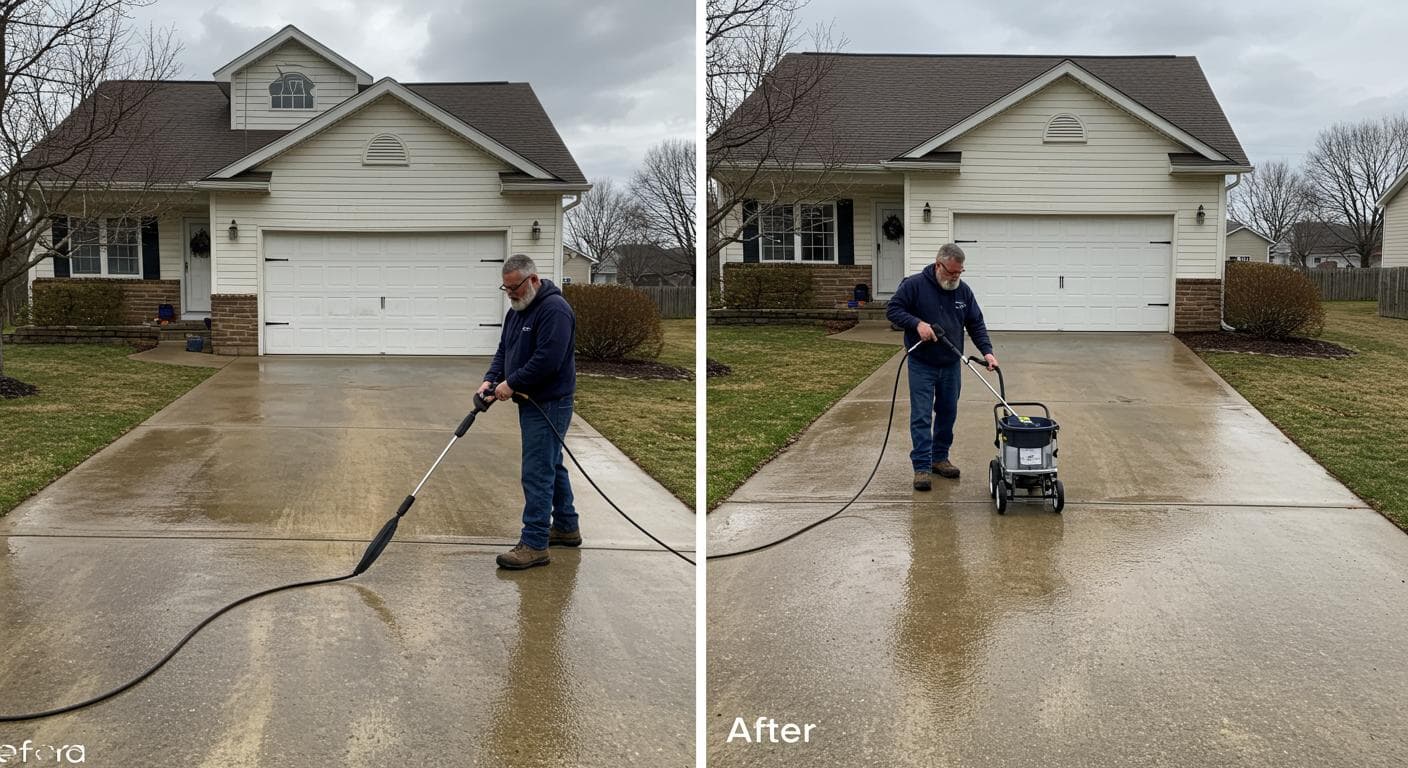
So the honest Denver answer is that most of your house should never meet high pressure at all. Brick gets a low pressure soft wash with a cleaning solution doing the work. The machine gets pointed at the driveway, the patio and the garage floor, where it belongs.
What Too Much Pressure Does to a Denver Bungalow
You can find out what you own in about ten seconds. Go to a shaded brick on the north or east side of the house, out of the weather, and drag a house key firmly across the face of one brick.
If you get a fine red or orange dust on the key and a visible pale line on the brick, that is soft brick with a worn face, and a pressure washer set for concrete will take the rest of it off in one pass. If the key skates across and leaves nothing but a metal smear, the face is still hard and you have more room.
Do the same to a mortar joint. Push the key tip into the joint and twist. Lime mortar from the era most of central Denver was built in will crumble to sand under light pressure. Modern portland mortar will not budge. A joint that crumbles for a key will wash straight out under a wand, and once the joints are open, water gets behind the wall instead of running down the front of it.
This is where altitude stops being trivia. A January afternoon here can put a south facing brick wall well above freezing while the overnight low drops into the teens, and the wall crosses that line again and again through one winter. Every crossing lets water inside an opened brick face expand and push a flake off. That damage shows up two springs later as pitted brick and a mortar bill that dwarfs the cleaning cost.
There is one thing worth refusing out loud. If a crew unpacks a zero degree tip, the narrow one that fires a single pencil jet, that tip has no business anywhere on your house. Not the brick, not the siding, not the window trim, not the soffit. Tell them plainly it does not get used on the building and watch how they react, because a crew that argues about it is telling you how they clean.
Your Driveway Problem Is Salt, Not Dirt
Every spring Denver garage floors and driveway aprons come out of winter wearing a chalky white haze that looks like the concrete has faded. People book a pressure wash to blast it off, it comes back within weeks, and they blame the crew.
That haze is mostly the magnesium chloride deicer that gets sprayed on Front Range roads, carried home in your tire treads and dripped onto the concrete every time the car thaws out in the garage. It is a salt that has soaked into the pores of the slab. Pressure lifts the surface film and leaves the rest sitting inside the concrete, so it wicks back to the top and looks untouched.
What actually moves it is chemistry and dwell time. A crew that knows Denver concrete will apply a cleaner made for salt and efflorescence, let it sit and work, then rinse at moderate pressure. If someone quotes your spring driveway with nothing but a surface cleaner attachment and no product, they are selling you the same job again next year.
The second concrete issue is what sits under the slab. Much of the metro is built on clay soil that swells when it takes on water and shrinks when it dries, which is why so many Denver driveways have that one seam that keeps lifting. Flooding an open crack near the house pushes water exactly where you do not want it. A careful crew works away from the foundation and never parks the wand over a crack.
Ask one more question on the phone before anyone books. Where does the dirty water go. If the answer is down the driveway into the street drain, say no. Storm drains in Denver run to the creeks and the South Platte with no treatment in between, and detergent, salt and mildew wash do not belong there. A crew set up properly berms the runoff onto turf or a planting bed where the soil filters it. The good ones tell you before you ask.
Choosing a Pressure Washing Crew in Denver
A 1912 brick square and a 2007 stucco build in Green Valley Ranch are two different jobs. A quote given without that question is a quote given without looking.
The right answer is low pressure and a cleaning solution that does the work. Anyone promising to blast the house clean is describing the damage, not the service.
Onto the lawn or a planting bed, not into the street drain. This is the fastest way to tell a real operation from a truck with a machine in it.
Colorado does not license pressure washing as a trade, so there is no license number to check. The certificate of insurance is the document that matters. Ask for a copy with your address on it.
Clearing winter mag chloride out of concrete needs product and dwell time. A crew that folds it into a flat rinse price has not planned to actually do it.
Pressure Washing Costs in Denver CO
These are typical Denver ranges, here so you can sanity check a quote instead of replacing one. Older brick homes in the central neighborhoods usually land at the upper end, because the safe method is slower and the crew has to protect windows, sills and landscaping as they go.
The Denver Window Is Narrower Than You Think
Anything that wets masonry needs the wall to dry fully before the next hard freeze, which quietly rules out a good part of the Denver calendar. Late spring through early fall is the safe stretch. A warm week in November tempts people, but a north facing brick wall barely sees the sun here and can still be holding water when the temperature drops that night.
Altitude also makes midday harder than it looks. Dry air and strong sun at this elevation flash dry a cleaning solution off a south or west wall before it has worked, and a solution that dried did nothing. Crews who know this start on the shaded side, follow the sun around the house and keep the surface wet while the product works. A quote that has your whole exterior done in ninety minutes on a sunny July afternoon is a rinse sold as a wash.
Water comes up in every Denver conversation involving a hose. A pressure washer moves less water per minute than an open garden hose, so a house wash is not the water hog people assume. Denver Water publishes its current rules and restrictions on its own site, and they change from year to year, so check there before you book.
One last local wrinkle. Parts of Denver sit inside designated historic districts, and exterior work on a landmarked property can need review before it happens. Cleaning historic masonry is exactly the sort of work preservation staff have opinions about, for the same soft brick reasons above. If your block has a historic district sign on it, a call to Denver Landmark Preservation before booking costs you nothing and can save an argument later.
Contractor Palace does not wash anything. We match you with independent local Denver crews, the pro you book does the work, and there is no charge to you at any point.
Common Questions About Pressure Washing in Denver CO
Is pressure washing safe on my old Denver brick?
High pressure is not. A soft wash at low pressure with a cleaning solution is, and that is what almost every pre-war brick home in Denver should get.
Test it yourself first. Drag a house key across a brick face in a shaded spot. Red dust on the key means the face is worn and soft, and a crew that still wants to run a high pressure tip on it should not get the job.
Why does the white haze on my driveway keep coming back?
Because it is not dirt. It is mostly magnesium chloride road deicer that has soaked into the concrete over the winter, and rinsing only removes what is sitting on the surface.
It needs a cleaner made for salt and efflorescence, left to dwell, then a moderate pressure rinse. Priced as its own line item, not folded into a plain wash.
Do Denver pressure washing companies need a license?
Colorado licenses electricians and plumbers at the state level. It does not license pressure washing as a trade, so there is no license number for you to look up.
General liability insurance is what to verify instead. Ask for the certificate with your property address on it, and ask what their plan is for the wash water before it reaches the street drain.
When should I book it?
Late spring through early fall, so a masonry wall has time to dry out before the next hard freeze. Shoulder season washes on north facing brick are how you get spalling.
On a hot sunny day, expect a good crew to start on the shaded side of the house. Dry air at this elevation dries cleaning product off a sunlit wall before it has worked.
Do you do the washing yourselves?
No. Contractor Palace matches you with independent local Denver pressure washing pros and the crew you book does the work. There is no charge to you.
More around Denver
Other Contractor Palace pages worth a look before you book.
Need pressure washing in Denver? Get matched free.
Tell us what the house is made of and roughly when it was built. We match you with an independent local Denver crew who soft washes the brick and saves the pressure for the concrete. No charge to you.
Get my free Denver pressure washing quotearrow_forward