
Pest Control in Lakewood: One City, Two Different Jobs
Lakewood has a 2,400 acre piece of unimproved open space sitting inside its own city limits. William F. Hayden Park covers Green Mountain, a mesa topping out at 6,854 feet, and on the west side of town subdivisions back straight onto it with nothing between the last house and the dry grass but a fence.
So a Lakewood pest quote is really two jobs sharing one name. On the west side you are buying wildland edge exclusion, sealing a building against an open hillside and everything living on it. On the east side, in the older grid pressed up against Denver, you are buying conventional urban rodent work on 1950s and 1960s housing. Same city, same building department, two different scopes of work.
Which one you are buying is decided by your back fence, not by the company you call. Tell whoever quotes you which side you are on before they name a price.
Backing Onto Green Mountain Is a Wildland Edge Job
Hayden Park is not a park with mown turf and a sprinkler clock. It is unirrigated grass, scrub and rock across a hillside bigger than most Front Range neighborhoods, and it holds a rodent population that has never heard of your property line.
Mice and voles come off that ground and stop at the first solid structure they meet. If that structure is your house, what you have is a supply problem, not an infestation. Interior traps deal with the ones already inside and do nothing at all about the ones still walking downhill. Snakes follow the same food, which is why the honest answer to a snake in the window well is usually a rodent plan.
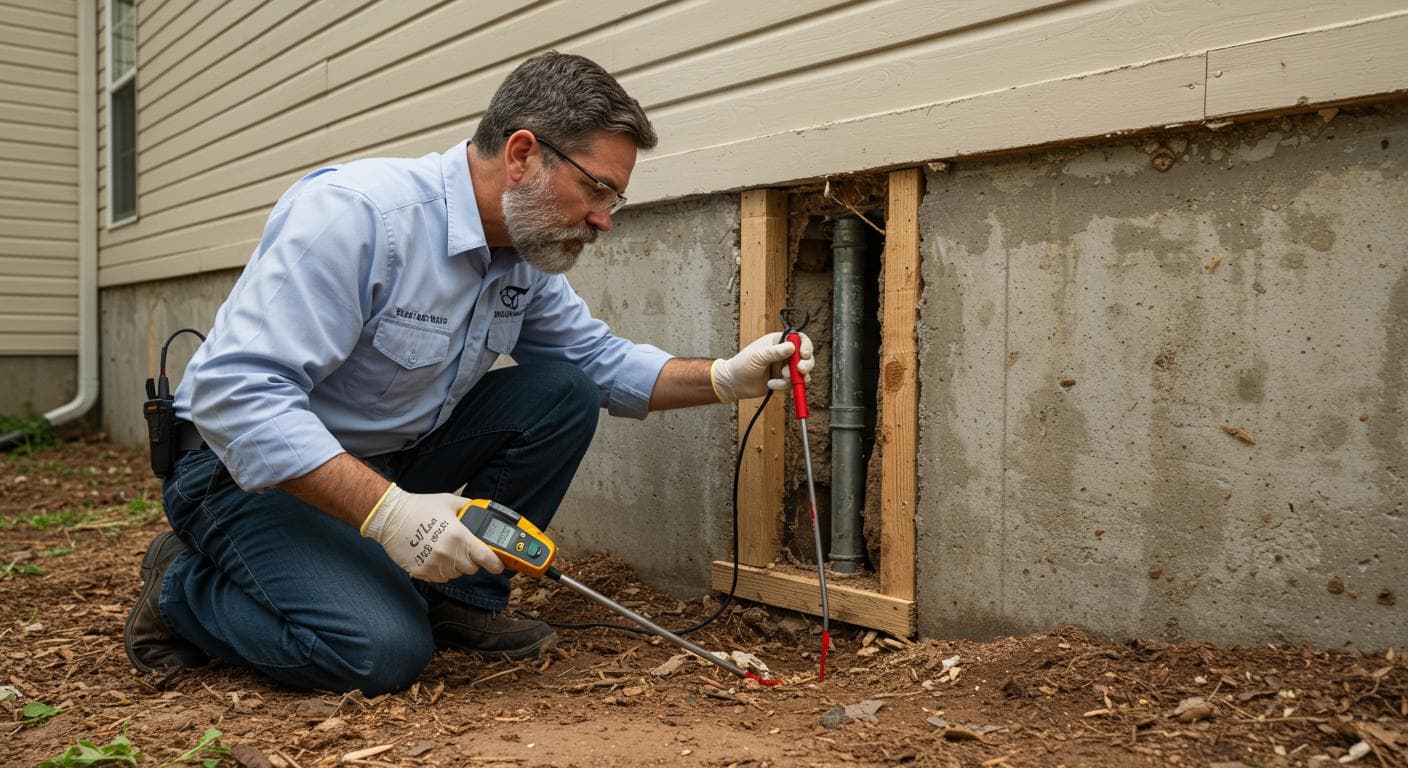
The work that holds on this side of Lakewood is exclusion at the building envelope. The bottom seal of the garage door and both of its corners, dryer and bathroom vent hoods, the gap where the gas line and the air conditioner line set punch through the wall, crawlspace vent screens and the joint where a deck ledger board is bolted back to the siding.
Here is a free five minute test before anyone quotes you. Tonight, close the garage door, turn off the light and lie down on the slab at each bottom corner. If daylight shows through or a pencil slides under the rubber, you have just found the most heavily used rodent door on the west side of this city, and you found it without paying anyone.
The yard matters as much as the wall. Everything in the first three feet of the foundation is an on ramp: dense juniper beds grown into the siding, firewood stacked against the house, ground level bird feed and a shed floor sitting flat on the dirt. Thinning that band does a second job here too, because the same open space that sends the rodents is why West Metro Fire talks to this side of town about defensible space.
Voles are the west side specialty that catches new owners out. They mostly stay outside, tunnel under snow all winter and girdle the bark off young trees, and you discover the damage in spring when the snow goes. Vole work is half landscaping. A pro who only offers bait and never mentions thinning ground cover or guarding young trunks is doing half the job.
The Gulches Are the Road Into Old Lakewood
Near Belmar, Eiber, Two Creeks or the West Colfax corridor there is no open space behind you, and it still finds a way in. Four drainages run east across the city, Lakewood Gulch, Weir Gulch, Sanderson Gulch and Bear Creek, with Turkey Creek joining Bear Creek inside city limits. Those green corridors are continuous cover with water, and mice, raccoons and skunks use them the way you use Colfax.
Then they arrive at the oldest housing stock in Lakewood. The inner east side is largely 1940s to 1960s brick ranches, bungalows and bi-levels, so you get crawlspaces, original utility penetrations cut by whoever ran the line and rim joists that were never sealed because nobody sealed them in 1957.
The part almost nobody explains is the soil. Lakewood sits on expansive clay from the Pierre Shale, which Jefferson County calls moving soils, and it swells when wet then shrinks when it dries. That movement reopens gaps at the sill plate, at the porch slab, at the meter penetration and along a settled foundation wall every single season. A house that was properly sealed four years ago can be open again now. That is why rodent trouble in a seventy year old Lakewood home keeps coming back, and why traps alone become a monthly bill instead of a fix.
After the next real soaking, go walk the outside of the house and look at where each downspout is actually dumping. Any downspout letting water out within a foot of the wall is soaking the exact clay you need to hold still. Moving that discharge out past the drip line is an afternoon with no contractor and nothing bought, and it slows the yearly reopening of every gap along that wall.
Find the radon pipe before anyone seals your basement
Jefferson County is an EPA Radon Zone 1 county, the highest potential class, and the statewide indoor average in Colorado is 6.4 pCi/L against an EPA action level of 4.0. So a lot of Lakewood basements have a sub slab mitigation system, a PVC pipe out of the slab with a fan on it. Go find yours, photograph the slab penetration and the sump lid, then show the exterminator before any foam goes into a floor crack. Sealing done blind can wreck the suction that system relies on, and nothing beeps when it happens.
One more Lakewood call worth heading off. Emerald ash borer was confirmed here in September 2024, found in central Lakewood and confirmed through the CSU Extension office in Jefferson County, and homeowners now phone pest control about their ash trees. That is a tree job. The credential to ask for is an ISA certified arborist, and a pest company that cheerfully quotes you an ash treatment is working outside its lane.
Pest Control Costs in Lakewood CO
Typical Lakewood ranges, here so you can sanity check a quote instead of replacing one. Houses on the Green Mountain edge sit at the top of the exclusion range, because there is more perimeter to close.
Choosing an Exterminator in Lakewood
A house on the Hayden Park edge and a bungalow off West Colfax are different scopes of work. Anyone who quotes before asking what is behind your fence is reading from a script.
Pesticide applicators in this state are licensed by the Department of Agriculture, and that number is checkable. Ask for it on the phone. A company that will not say it has answered the question.
On moving clay soil, gaps reopen every season. If sealing is not its own line item with a written scope, you are buying a subscription instead of a repair.
Jefferson County is Radon Zone 1, so assume a mitigation system exists until you have both looked for the pipe. Sealing around it blind is how a working system quietly stops working.
Common Questions About Pest Control in Lakewood CO
What does pest control actually cost in Lakewood?
A one time interior and perimeter treatment usually runs $150 to $340, and a quarterly plan lands around $95 to $190 a visit. Rodent work is the number that moves: exclusion and sealing runs about $350 to $950, and a Green Mountain edge house with a crawlspace and a long perimeter can sit above that.
Make them break the quote into treatment and sealing as separate line items with the openings listed. One lump number with no scope written down cannot be compared against anyone else, which is usually why it arrives that way.
Why do the mice come back every fall even though we sealed the house?
Because Lakewood sits on expansive Pierre Shale clay, which Jefferson County calls moving soils. It swells wet and shrinks dry, and that motion pulls open new gaps at the sill plate, the porch slab and the utility penetrations year after year.
On the west side there is a second reason stacked on top. Open space against the fence resupplies the pressure every autumn, so a seal that held one winter is being tested by a fresh population the next. Ask for a re inspection of the same sealed points rather than a new round of traps.
Something is living under my deck near the gulch. Is that the same call?
Not quite. Raccoons and skunks moving up Weir, Sanderson, Lakewood Gulch or Bear Creek are a wildlife exclusion job, which means a one way door, confirming nothing is left underneath, then screening the skirt properly.
Plenty of general pest companies do not handle wildlife at all, so ask on the first call. And be wary of anyone reaching for poison for an animal that lives outdoors, because it dies somewhere you cannot reach and then you have two problems.
Do I need a permit for any of this in Lakewood?
Not for the pest treatment itself. Applicators are regulated by the Colorado Department of Agriculture, not by the city.
It changes if the fix turns into construction. Cutting in a new crawlspace access, replacing siding or rebuilding a soffit is Lakewood Building Division work through the city eTRAKiT portal, and that contractor must hold a City of Lakewood registration, which is separate from any state license. Ask who is pulling that permit before work starts, and refuse a vague answer.
Will sealing the basement mess with my radon system?
It can, and Jefferson County being an EPA Radon Zone 1 county means a lot of Lakewood houses have one. The system is a PVC pipe out of the slab with a fan on it, and it depends on the slab staying sealed and under suction.
Locate the pipe yourself, look at the sump lid and the slab penetration, then point them out before anybody foams a crack for rodents. Good pest work and a working radon system are compatible, but only when the person with the caulk gun knows the system is there.
Do you treat the property yourselves?
No. Contractor Palace matches you with independent local Lakewood pest control pros, and the pro you book does the work. Ask for their Colorado Department of Agriculture applicator license number. There is no charge to you.
More in Lakewood
Other Contractor Palace pages for this part of Jefferson County.
Need an exterminator in Lakewood? Get matched free.
Tell us what you are seeing and whether you back onto open space or sit closer to a gulch. We match you with a Lakewood pest control pro who walks the perimeter before quoting. No charge to you.
Get my free Lakewood pest control quotearrow_forward