
Concrete Denver: Local Concrete Contractors for the Front Range
Concrete work in Denver is not the same as concrete work anywhere else. The expansive bentonite clay soils across the Front Range, combined with 300 days of sunshine, high altitude evaporation and hard freeze-thaw winters, make proper subgrade preparation and curing technique more important here than in most markets. Contractor Palace connects Denver homeowners with concrete contractors who know how to work in this specific environment, pouring driveways, patios, walkways, foundations and decorative stamped concrete that lasts rather than heaves, spalls or cracks within a few seasons.
What Concrete Contractors in Denver Do
A concrete contractor covers a wide range of flatwork and structural concrete projects. In the Denver metro, the most common residential scopes are driveways, patios, walkways, pool decks, garage slabs, basement floors and decorative or stamped concrete finishes. On the commercial and pre-construction side, contractors pour foundation slabs, stem walls, concrete curbs and flatwork for parking lots and commercial properties in Aurora, Lakewood and the broader metro area.
Concrete driveways
Full replacement or new pour. Proper subgrade excavation, compacted gravel base, reinforcement with rebar or fiber, control joints and a broom or exposed aggregate finish. Denver driveways need thicker slabs and proper joint spacing to handle freeze-thaw movement.
Concrete patios
Flatwork pours with optional decorative finishes. Stamped concrete patterns, exposed aggregate, broom finish and colored concrete are all common in Denver patio projects.
Stamped and decorative concrete
Color pigment added to the mix, pattern stamps applied before the slab sets and a protective sealer applied after curing. Denver's high UV environment requires UV-resistant sealers reapplied every two to three years.
Concrete repair
Crack routing and filling, slab lifting with mudjacking or polyurethane foam injection, surface resurfacing to address scaling or spalling caused by de-icing salt damage.
Foundation slabs and footings
Structural pours for new construction, additions and accessory dwelling units. Includes proper footing depth below frost line and moisture barriers on grade.
Walkways and steps
Paths, entries and exterior steps poured with proper slope for drainage and finished for slip resistance.
Concrete Cost Denver: What to Expect
Concrete cost in Denver reflects labor rates, material costs and the additional prep work that Front Range soil conditions require. The ranges below are for typical residential projects in the Denver metro. Your actual cost depends on site access, existing concrete removal, soil conditions and the finish type you choose.
Denver Pricing Note
These ranges reflect Denver metro market rates. Expansive clay soil often requires additional gravel base material and more excavation depth than flat states, which adds 10 to 20 percent to prep costs compared to national averages. Get a firm written quote with itemized line items for excavation, base material, reinforcement and concrete mix before signing anything.
How Concrete Work Gets Done in Denver
Concrete is not just a pour. Each step in the process affects the final result. Here is what a professional concrete contractor does from start to finish on a Denver driveway or patio project.
Site assessment and subgrade evaluation
A skilled Denver concrete contractor examines the existing soil before any pricing is finalized. Expansive bentonite clay is common across the Front Range. Where it is present, the contractor excavates deeper, removes more soil and installs a thicker compacted gravel base to reduce heave risk. Skipping this step is the single biggest reason concrete cracks in Denver.
Excavation and base preparation
Concrete is excavated to the required depth, typically 4 to 6 inches for a driveway slab plus 4 to 6 inches of compacted gravel below. The base is graded for drainage slope, compacted in lifts and checked for uniform density. In clay-heavy areas, a layer of sand or engineered fill may be placed before gravel.
Forming and reinforcement
Wood or metal forms are set to the finished grade elevation. Rebar or welded wire mesh is placed on chairs to hold it at the correct depth within the slab. For driveways subject to heavy vehicles, 3/8-inch rebar on 18-inch centers is standard in Denver. For patios and walkways, fiber reinforcement or welded wire mesh is common.
Concrete mix and pour
In Denver, air-entrained concrete is used for all exterior flatwork. Air entrainment creates microscopic bubbles in the mix that give water room to expand during freeze-thaw cycles without cracking the slab surface. A minimum 4,000 PSI mix is standard for driveways. The contractor orders from a ready-mix plant and coordinates pour timing to avoid extreme heat or cold.
Finishing
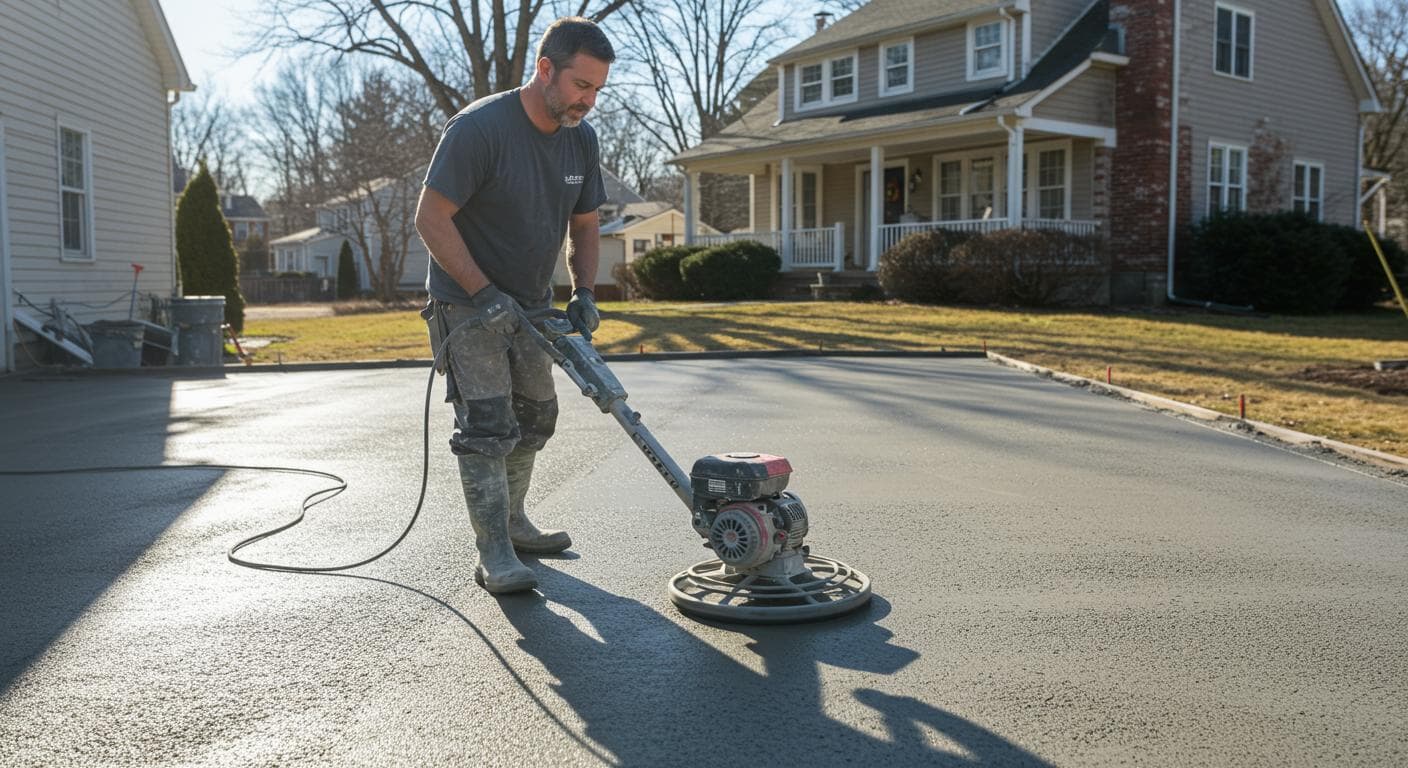
After the pour, the slab is screeded level, floated smooth and given its finish texture. A broom finish adds traction. Exposed aggregate is washed before the surface sets. Stamped patterns are pressed while the concrete is still plastic. Timing is critical at Denver's altitude, where low humidity and high sun can cause the surface to skin over faster than expected.
Control joints and curing
Control joints are cut to a depth of one-quarter the slab thickness within 24 hours of the pour. Proper joint spacing prevents random cracking by giving the concrete a designated place to crack. Curing compound or wet burlap is applied immediately after finishing to slow evaporation. At altitude with Denver's dry air, premature evaporation is a leading cause of surface cracking. The contractor monitors the slab for at least 7 days.
Types of Concrete Work for Denver Homes and Properties
Not all concrete projects are the same. Here is how the main residential concrete scopes compare in the Denver market so you can match your project to the right type of contractor and set realistic expectations for timeline and cost.
Standard flatwork concrete
Plain gray concrete poured in place and broom-finished. The lowest-cost option. Durable and low-maintenance. Best for driveways, back patios, utility walkways and garage floors where aesthetics are secondary to function.
Stamped concrete
Pigmented concrete with a pattern pressed into the surface while plastic. Popular patterns include flagstone, slate, cobblestone and wood plank. Stamped concrete in Denver requires UV-resistant color hardener and a quality sealer. Sealers need reapplication every two to three years due to intense UV and freeze-thaw cycling. Cost is typically two to three times standard flatwork.
Exposed aggregate concrete
The top layer of cement paste is washed away before it fully sets, exposing the aggregate beneath. Creates a textured, slip-resistant surface with a natural stone appearance. Common on front walkways and pool decks across Aurora and Centennial.
Concrete repair and resurfacing
For slabs that have scaled, spalled or cracked but are structurally sound, a concrete overlay or resurfacer can extend life by 10 to 15 years. Not appropriate for slabs with heave damage from underlying soil movement, which requires removal and replacement with proper subgrade prep.
Mudjacking and slab leveling
Sunken slabs caused by soil settlement can often be lifted without full replacement. Mudjacking injects a grout slurry beneath the slab. Polyurethane foam injection is a faster, lighter-weight alternative. Neither method addresses the underlying cause in expansive clay soils, so results vary.
Denver Soil and Climate: What Every Concrete Job Here Demands
Denver sits on top of one of the most challenging subgrade environments in the country for flatwork concrete. Understanding the soil and climate conditions in the Front Range is the single most important factor in whether your driveway or patio holds up for 20 years or starts heaving and cracking within three.
Expansive Bentonite Clay Soils
The Front Range sits on expansive bentonite clay deposits that absorb water and swell significantly when wet, then shrink when dry. A concrete slab placed on this soil without proper preparation will be pushed upward when the clay expands and drop back down when it dries, repeating this cycle through every wet and dry season. Over time, the slab cracks, tilts and becomes a trip hazard.
The fix is not a thicker slab. The fix is aggressive subgrade preparation: excavate the clay to a sufficient depth (often 6 to 12 inches for problematic areas), replace it with non-expansive fill and compact a thick gravel base before forming. A concrete contractor who skips this because it adds cost is giving you a slab that will fail on an accelerated timeline. Contractor Palace vets contractors on their subgrade process specifically because this step is where corners get cut on Front Range projects.
Front Range Soil Warning
Freeze-Thaw Cycles and De-Icing Salt Damage
Denver averages around 155 freeze-thaw cycles per year, far more than most cities at lower elevations. Every time moisture gets into concrete pores and freezes, it expands and breaks the surface from the inside. Over multiple seasons, this produces scaling and spalling on the top inch of the slab.
The solution is air-entrained concrete. Air entrainment adds microscopic air bubbles that act as pressure-relief chambers during ice expansion. It is standard practice for exterior flatwork in Colorado and any contractor not specifying it on a Denver project is not following best practice. Proper curing and a penetrating concrete sealer applied after curing also reduce freeze-thaw surface damage significantly.
De-icing salts accelerate surface deterioration. Sodium chloride and calcium chloride products used on driveways to melt ice chemically attack concrete paste and work together with freeze-thaw action to scale surfaces faster. If de-icers are used regularly on a Denver driveway, plan to reseal every one to two years and expect the surface to show wear more quickly than a non-salted slab.
High Altitude Curing Challenges
At 5,280 feet, Denver has lower atmospheric pressure, lower humidity and more intense UV radiation than lower-elevation markets. These conditions combine to pull moisture out of a fresh concrete slab faster than at sea level. If the concrete surface loses moisture before the cement hydration reaction completes, the top layer shrinks relative to the rest of the slab and surface cracking results, often appearing within the first 24 to 48 hours.
Proper curing practice in Denver means applying a curing compound immediately after finishing, or covering the slab with wet burlap and plastic. On hot, dry, windy days, an evaporation retarder misted on the surface during finishing buys additional time. A Denver concrete contractor who pours a slab in July and does nothing for curing is taking a shortcut that shows up as cracking within a season.
Control Joints and Joint Spacing
Concrete shrinks as it cures. Without somewhere to crack in a controlled way, it cracks randomly where the stress concentrates. Control joints give the concrete a designed weak point to crack at, hidden in the joint rather than across the middle of a driveway bay. In Denver, where thermal expansion and soil movement add additional stress to slabs, proper joint spacing is critical.
Standard practice is joint spacing in feet that does not exceed two to three times the slab thickness in inches. A 4-inch slab gets joints every 8 to 10 feet. On a long driveway, that means joints every 8 to 10 feet across the width and the same distance down the length. Contractors who space joints too far apart are handing the crack formation over to chance.
Serving Denver and the Front Range Metro Area
Contractor Palace matches homeowners with concrete contractors across the Denver metro. Whether you are in Denver proper, the suburban communities south of the city or the older neighborhoods in Lakewood to the west, we have concrete professionals who know the specific soil conditions and building requirements in your area.
Concrete work in Highlands Ranch and Centennial, built heavily from the 1990s onward on the southern clay belt, often involves more aggressive subgrade prep than older Denver neighborhoods. Contractors who specialize in the south metro understand this and price accordingly. Aurora on the eastern edge of the metro has a mix of soil conditions depending on the specific neighborhood. Your matched concrete contractor knows what to look for before finalizing a quote.
Colorado Licensing and Denver Permits for Concrete Work
Colorado has no statewide general contractor license and no state-level concrete contractor license. This means anyone can legally call themselves a concrete contractor in Colorado without demonstrating any formal credentials to a state board. Vetting your contractor matters more here than in states with stricter licensing.
What to verify before you hire a concrete contractor in Denver:
General liability insurance
At minimum $1 million per occurrence. Ask for the certificate of insurance naming you as an additional insured on the project. If the contractor declines or cannot produce one, do not hire them.
Workers compensation insurance
If a crew member is injured on your property and the contractor carries no workers comp, you can be held liable. Verify coverage before work begins.
Denver building permits
Concrete work that involves new structures, retaining walls over 30 inches, or work adjacent to public right-of-way may require a permit from Denver Community Planning and Development. Your contractor should know when a permit is required and pull it before breaking ground.
References from local Denver metro projects
With no licensing requirement, references from completed local projects are the most reliable vetting signal. Ask for two to three recent projects in the Denver metro and follow up on them.
Written contract with mix specs
A legitimate concrete contractor provides a written contract that specifies concrete PSI, air entrainment, reinforcement type, base depth and joint spacing. Verbal commitments on these specs are not enforceable.
Denver Permit Note
How to Choose a Denver Concrete Contractor
Choosing the right concrete contractor in Denver comes down to three things: do they understand Front Range soil conditions, can they prove their insurance and do they provide a written specification for the job. Here is what to ask and what to listen for.
Ask about their subgrade process
A qualified Denver concrete contractor immediately talks about soil conditions, excavation depth and base material. If they quote you a price before asking about your soil or looking at the site, they are skipping the step that matters most on Front Range projects. Get another quote.
Confirm air-entrained concrete
Ask specifically whether they are specifying air-entrained concrete for your project. It should be an automatic yes for any Denver exterior flatwork. If they seem unsure what air entrainment is, or say it is not necessary, they are not up to date on standard Colorado practice.
Get joint spacing in writing
Ask what control joint spacing they plan to use and have it written into the contract. A contractor confident in their work will have no problem specifying this. One who resists putting it in writing is hedging against being held to a standard.
Request mix specifications
The concrete mix spec should list minimum PSI strength, air entrainment percentage and any fiber or rebar reinforcement. A 4,000 PSI air-entrained mix is the baseline for Denver driveways. Ask for these specs before signing.
Verify insurance with a certificate
Do not accept a verbal confirmation. Request the actual certificate of insurance from the contractor's insurance agent, delivered to your email. This takes five minutes for a legitimate contractor and gives you a real document you can verify.
Frequently Asked Questions About Concrete in Denver
How much does a concrete driveway cost in Denver?
A standard two-car concrete driveway in Denver runs $4,500 to $9,000 for a new pour on a prepared base, depending on size, access and finish. Full replacement including removing the old concrete and hauling it off adds $2 to $5 per square foot to the total. Driveways in clay-heavy areas often require more excavation and base material, which pushes costs toward the higher end of the range. Stamped or colored concrete driveways run $15 to $28 per square foot installed.
Why does concrete crack so much in Denver?
Three factors cause most concrete cracking in Denver: expansive clay soil that swells and shrinks seasonally, freeze-thaw cycling that stresses the slab surface and premature drying due to high altitude and low humidity. Proper subgrade preparation with excavated clay replaced by compacted gravel, air-entrained concrete mix and correct control joint spacing addresses all three. A slab poured without these practices on Denver Front Range soils is unlikely to stay crack-free for more than a few years.
Do I need a permit for a concrete driveway or patio in Denver?
A replacement driveway in the same footprint as the existing one typically does not require a permit from Denver Community Planning and Development. However, expanding a driveway that changes the curb cut, adding a new curb cut, building a retaining wall over 30 inches or any work in the public right-of-way does require permits. Your matched concrete contractor evaluates permit requirements at the site visit and pulls them if needed before work begins.
Is stamped concrete a good choice for Denver patios?
Stamped concrete works well in Denver when properly installed and maintained. The key requirements are a quality air-entrained base mix to handle freeze-thaw cycles, a UV-resistant color hardener applied during the pour and a penetrating sealer applied after curing and reapplied every two to three years. Denver's intense UV will fade unsealed colored concrete noticeably faster than in lower-elevation markets. Properly maintained stamped concrete in Denver holds up well for 15 to 20 years.
How long does concrete take to cure in Denver?
Concrete reaches enough strength to walk on in 24 to 48 hours and enough to drive on in 7 days under normal conditions. Full cure strength takes 28 days. At Denver's altitude with low humidity, the curing process can be disrupted if the contractor does not apply a curing compound or wet cure the slab during the first week. Do not let vehicles on a new Denver driveway for at least 7 full days and avoid any de-icing products in the first winter after a new pour.
What is the difference between rebar and fiber reinforcement for concrete?
Rebar provides structural tensile strength and is best for slabs that need to span gaps or carry heavy loads such as vehicle driveways and garage floors. It reduces the width of cracks if cracking occurs. Fiber reinforcement adds plastic or steel fibers throughout the mix that control shrinkage cracking during the initial curing period and improve surface impact resistance. Many Denver contractors use both: rebar for structural support and fiber for crack control. For a residential patio, fiber alone is often sufficient. For a driveway, rebar is the stronger choice.
Ready to start your concrete project in Denver? Let’s get you matched.
Post your project free. Get matched with a verified Denver concrete contractor who knows Front Range soil conditions and Colorado requirements. Upfront pricing.
Get my free Denver concrete quotearrow_forward