
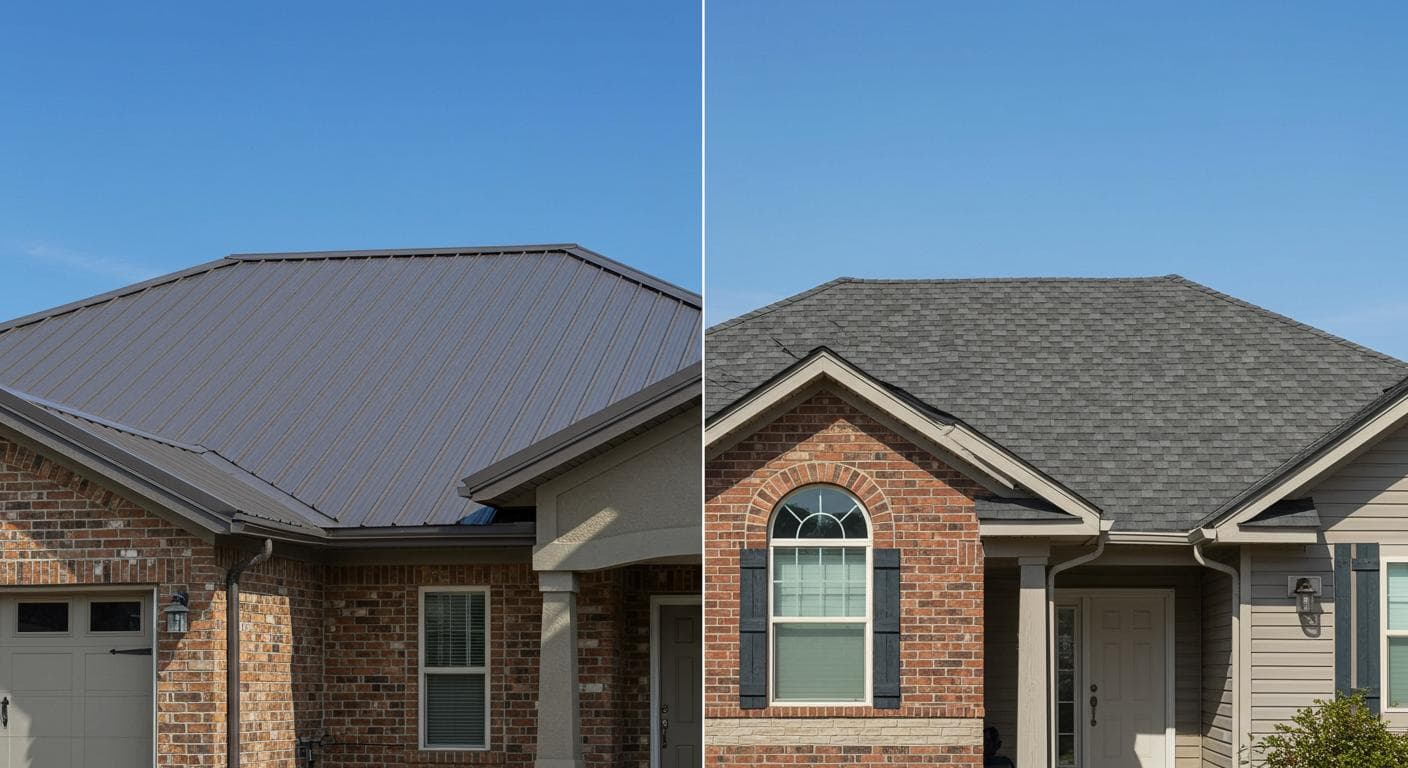
Choosing between a metal roof and asphalt shingles is one of the biggest financial decisions a homeowner makes. Get it right and you could be done with roofing for 50 years. Get it wrong and you have paid a premium for a product that did not fit the house, the climate or the budget.
Weather throws a lot at roofs. Wet springs, hot summers, heavy snow and freeze-thaw cycles all do real damage to anything that absorbs moisture. Both metal and shingles can work almost anywhere. But they perform differently, cost differently and suit different homeowners. This guide lays out the facts so you can make the call.
Upfront Cost of Metal Roofing vs Asphalt Shingles
Price is where shingles win outright. For a typical home with 1,800 to 2,200 square feet of roof area, here is what roofers are currently quoting:
3-Tab Asphalt Shingles
The entry-level option. Installed cost runs 6,000 to 10,000 dollars on a standard home. Lifespan of 15 to 20 years. No longer recommended by most roofers because architectural shingles are only slightly more expensive and significantly more durable. Rarely specified on new builds.
Architectural (Dimensional) Asphalt Shingles
The most common choice on homes in most markets. Installed cost runs 9,000 to 16,000 dollars. Lifespan of 25 to 30 years with a quality product like Owens Corning Duration or GAF Timberline HDZ. Dimensional texture improves curb appeal over 3-tab. This is the baseline most homeowners compare everything against.
Metal Panels (Exposed Fastener / Corrugated)
Mid-range metal option. Installed cost runs 11,000 to 22,000 dollars. Common on rural properties and outbuildings but increasingly used on residential homes. The exposed screws are a maintenance point: rubber-gasketed fasteners can degrade in 15 to 20 years and need re-sealing. Lifespan of 30 to 45 years.
Standing-Seam Metal Roof
Premium residential metal roofing. Installed cost runs 18,000 to 40,000 dollars. Concealed fasteners mean no exposed screws to fail. This is what most roofers mean when they talk about a metal roof on a home. Lifespan of 40 to 70 years. The most common products used by roofers include AEP Span, McElroy and Fabral panels in Galvalume or Kynar-coated steel.
The math shifts when you factor in lifespan. A 12,000-dollar shingle roof replaced twice over 60 years costs 24,000 dollars plus two rounds of tear-off labor. A 28,000-dollar standing-seam metal roof covers that same 60 years with no replacement. Run the numbers for your situation before assuming shingles are cheaper.
Lifespan and Durability in Real Weather
Climate drives how long a roof lasts. Humid summers, cold winters, heavy snow and repeated freeze-thaw cycles all wear on roofing, and strong sun wears on it in a different way. Here is how each roofing type holds up.
Asphalt Shingles in Hard Weather
Asphalt granules wash off over time, especially on north-facing slopes that stay wet longer. Freeze-thaw cycles cause shingles to expand and contract, eventually cracking the asphalt layer and loosening granules. Most shingle roofs installed in the 1990s are already past their useful life. A quality 30-year shingle realistically lasts 22 to 28 years in a hard-winter climate.
Metal Roofing in Hard Weather
Metal does not absorb moisture so freeze-thaw cycles have almost no effect on the material itself. Steel roofing with a quality Kynar 500 or SMP coating resists UV degradation and chalk for 30 to 40 years. Impact resistance depends on the gauge and profile: most standing-seam roofs carry a UL 2218 Class 4 impact rating, which is the highest rating available. Snow loads are handled well because metal roofs are structurally stronger than shingles. The one caveat is thermal expansion: standing-seam systems are engineered to allow panels to expand and contract; exposed fastener systems need the fastener condition monitored every 10 to 15 years.
Snow, Ice Dams and Impact Resistance
Ask any roofer who works in a snowy region and they will tell you the same thing: ice dams are the single biggest source of repeat roofing calls. Here is what that means for your material choice.
Ice Dam Resistance
Ice dams form when heat escaping through a poorly insulated attic melts snow on the roof, the meltwater runs to the cold eave overhang and refreezes. Both metal and shingles are vulnerable to ice dam formation if the attic insulation is inadequate. The difference is what happens when meltwater backs up under the roofing material. Shingles are far more permeable at seams: water entering under lifted shingles soaks the deck and leaks into the ceiling. Metal standing-seam panels with hidden fasteners and properly lapped seams are dramatically more resistant to water infiltration under ice dams. Homeowners in snowy regions who switch to metal often report fewer ice-related leaks even before improving attic insulation.
Snow Shedding
Metal roofs shed snow faster because the smooth painted surface has much lower friction than granule-covered shingles. This is a structural benefit in heavy snow years: less accumulated load on the roof deck and walls. It can also be a hazard on walkways directly below the eaves, which is why snow guards are recommended on metal roofs over entries and driveways. Shingles hold snow longer, which means more sustained weight but also less avalanche risk from large sliding masses.
Impact Resistance
Roofing impact resistance is rated under UL 2218. A Class 4 impact-rated metal roof withstands 2-inch steel balls dropped from 20 feet without cracking, the highest rating in the test. Ratings vary by gauge and profile, so check the impact rating on the exact product you are quoted.
Energy Efficiency: What the Numbers Say
Metal roofing is marketed heavily on energy savings and the numbers are real but context-dependent. Here is what homeowners should actually expect.
A reflective metal roof coated in a light Kynar color (white, light gray, tan) can reduce summer cooling load by 10 to 25 percent compared to a dark asphalt shingle roof. The Oak Ridge National Laboratory has measured surface temperatures 50 to 60 degrees Fahrenheit lower on metal versus dark shingles in direct summer sun. In places where air conditioning runs most of the summer, that translates to real monthly savings on the electric bill.
The caveat: in cold climates, winters are a bigger energy cost than summers for most households. Dark shingles absorb solar heat in winter, which contributes slightly to passive warmth. A highly reflective metal roof does not. In practice, the difference on the heating side is small (maybe 1 to 3 percent) because most heat loss is through the attic insulation layer, not the roof surface. The net annual energy benefit of metal still leans positive, but do not expect dramatic savings if you already have good attic insulation. The bigger energy gain often comes from pairing the new roof installation with an attic insulation upgrade, regardless of material.
Head to Head: Metal Roofing vs Asphalt Shingles Compared
Upfront Cost
Shingles win. Architectural shingles: 9,000 to 16,000 dollars. Standing-seam metal: 18,000 to 40,000 dollars. The gap is real and not trivial for most homeowners.
Lifespan
Metal wins decisively. Quality shingles last 22 to 28 years in a hard-winter climate. Standing-seam metal lasts 40 to 70 years. Over 60 years you replace shingles two or three times versus zero times for metal.
Winter Performance
Metal wins. Better ice dam resistance, faster snow shedding, no moisture absorption, minimal freeze-thaw degradation.
Impact Resistance
Metal wins. Class 4 impact-rated metal roofs take heavy impact better than standard shingles.
Energy Efficiency
Metal wins (modestly). Reflective coatings reduce summer cooling load 10 to 25 percent. Winter difference is small. Benefit depends heavily on roof color and existing insulation.
Noise
Tie (on a properly insulated home). With attic insulation and solid decking, both materials perform similarly. Metal is louder only on structures with no insulation beneath.
Resale Value
Slight edge to metal. Both recoup a comparable percentage at sale, but a metal roof is a stronger listing differentiator because buyers recognize they will not face replacement costs.
Maintenance
Metal wins (mostly). Standing-seam needs little beyond clearing debris and checking trim seals every 10 years. Exposed fastener metal needs fastener inspection every 15 to 20 years. Shingles need moss/algae treatment, annual inspections and occasional re-caulking around flashings.
Aesthetics and Neighborhood Fit
Depends on the home. Metal looks exceptional on certain architectural styles (farmhouse, modern, contemporary). On a traditional colonial in a mature neighborhood, architectural shingles often blend better. Standing-seam is highly visible and some HOAs restrict its use.
Which Roof Is Right for Your Situation?
The honest answer is that metal roofing is the better long-term product in most cold and snowy climates. The reasons shingles still dominate the market are cost and familiarity, not performance. But metal does not make sense for every homeowner. Here is a practical breakdown.
Choose metal if you plan to stay in the home 15 or more years
The premium over shingles pays back through avoided replacements and energy savings, and that takes years. If you plan to be in the house that long, metal is the financially sound choice. If you are selling in the next few years, shingles are likely the smarter spend.
Choose metal if you live where winters are long and snowy
Heavy snow and long wet seasons push the durability advantage of metal higher. Roofers in snowy markets report shingle roofs failing significantly earlier than rated due to the combination of heavy snow, ice dams and extended wet conditions. Metal pays off faster in these regions.
Choose metal if falling branches or heavy impact are a worry
A Class 4 impact-rated metal roof is built to take hits that crack or bruise standard shingles. That matters most under mature trees.
Choose shingles if the budget is the binding constraint
A quality architectural shingle roof installed correctly will protect a home well for 25 or more years. If the 25,000 to 30,000 dollar difference between a good shingle roof and a standing-seam metal roof is money you need for other priorities, get a great shingle roof from a reputable roofer and do not look back.
Choose shingles if the home style or HOA restricts metal
Some municipalities and HOAs have restrictions on standing-seam metal. Traditional architectural styles with steep pitches and dormers often look better with dimensional shingles. Check your HOA rules and talk with a roofer who can show you both options on homes similar to yours.
When to Call a Roofer
Roofing is not a DIY job on a two-story house. The combination of fall risk, code requirements and long-term waterproofing consequences puts it firmly in professional territory. Here is when to call someone now rather than wait.
Your roof is 20 or more years old
Most shingle roofs are at or past the end of their functional life at 20 years. A roofer can probe for soft deck spots, check flashing condition and give you an honest remaining-life assessment. Waiting for an active leak means paying for interior damage in addition to the roof.
You see curled, cracked or missing shingles
Damaged shingles let water reach the deck. Have a roofer look at it before the next heavy rain, since small damage costs less to fix than a soaked deck.
You see staining or wet drywall near the roofline
Water stains on ceilings in upstairs rooms or attic mold are signs of active or intermittent leaks. Every wet-dry cycle expands the damage. Get someone on the roof within days, not weeks.
You are comparing metal vs shingles for a replacement
A roofer can walk the deck, assess the existing structure, pull the permit history and give you an actual bid on both options. The numbers in this article are market ranges; your home and your neighborhood will have specific factors that move the price. Two to three competitive bids is the right approach on any job over 10,000 dollars.
Find a Roofer Near You
Whether you are leaning toward metal or shingles, Contractor Palace connects you with independent local roofing contractors who work in your area. Before you hire, ask the pro for their license and proof of insurance. Get matched with a roofer who works in your zip code.
FAQ: Metal Roof vs Shingle Roof
How much more does a metal roof cost than shingles?
A standing-seam metal roof on a 2,000 sq ft home typically runs 18,000 to 40,000 dollars installed. A comparable architectural shingle job costs 8,000 to 16,000 dollars. Metal panels (exposed fastener) fall in the middle at 12,000 to 22,000. The gap narrows over time because metal lasts 40 to 70 years versus 20 to 30 for quality shingles, so you replace shingles twice or more in the same span.
Does a metal roof make a house louder in rain?
On a home with a proper attic and insulation, a metal roof is no louder than shingles during rain. The noise concern comes from metal roofs installed over open framing without any insulation layer beneath, which is common on barns and sheds. A residential installation with attic insulation and solid decking absorbs the sound difference. Most homeowners who switch report no meaningful difference in interior noise.
Is metal roofing better for snowy winters?
Generally yes. Metal roofs shed snow faster than shingles because snow slides off the smooth surface rather than accumulating. They do not absorb moisture so they resist the freeze-thaw cracking that shortens shingle life. Ice dams still form if attic insulation is poor, but metal is far more resistant to the water infiltration ice dams cause on shingle roofs. Homeowners in older homes with inadequate attic insulation often see fewer winter leak problems after switching to metal.
Does a metal roof increase home resale value?
Typically yes, though the return varies. Remodeling Magazine data puts metal roofing at a 61 to 85 percent cost recoup rate at resale, which is comparable to or slightly better than architectural shingles. The bigger benefit is marketability: a metal roof is a strong selling point because buyers know they will not face a roof replacement for decades. In a competitive market, a new metal roof can meaningfully differentiate a listing.
Can a metal roof be installed over existing shingles?
In many areas, building code allows one layer of metal roofing over existing shingles if the shingles are in sound condition and the roof deck is not damaged. Check your local code first. This saves the tear-off cost (roughly 1,000 to 3,000 dollars on a typical home) and adds a slight insulation benefit. However, many roofers recommend full tear-off so they can inspect the deck, fix any rot or soft spots and ensure the new roof has a clean substrate. Ask your roofer to pull back a section and inspect before deciding.
Contractor Palace
Get matched with an independent roofer today.
Metal or shingles, get an honest assessment from a roofer who can walk your roof and give you real numbers. Contractor Palace connects you with independent professionals near you.