
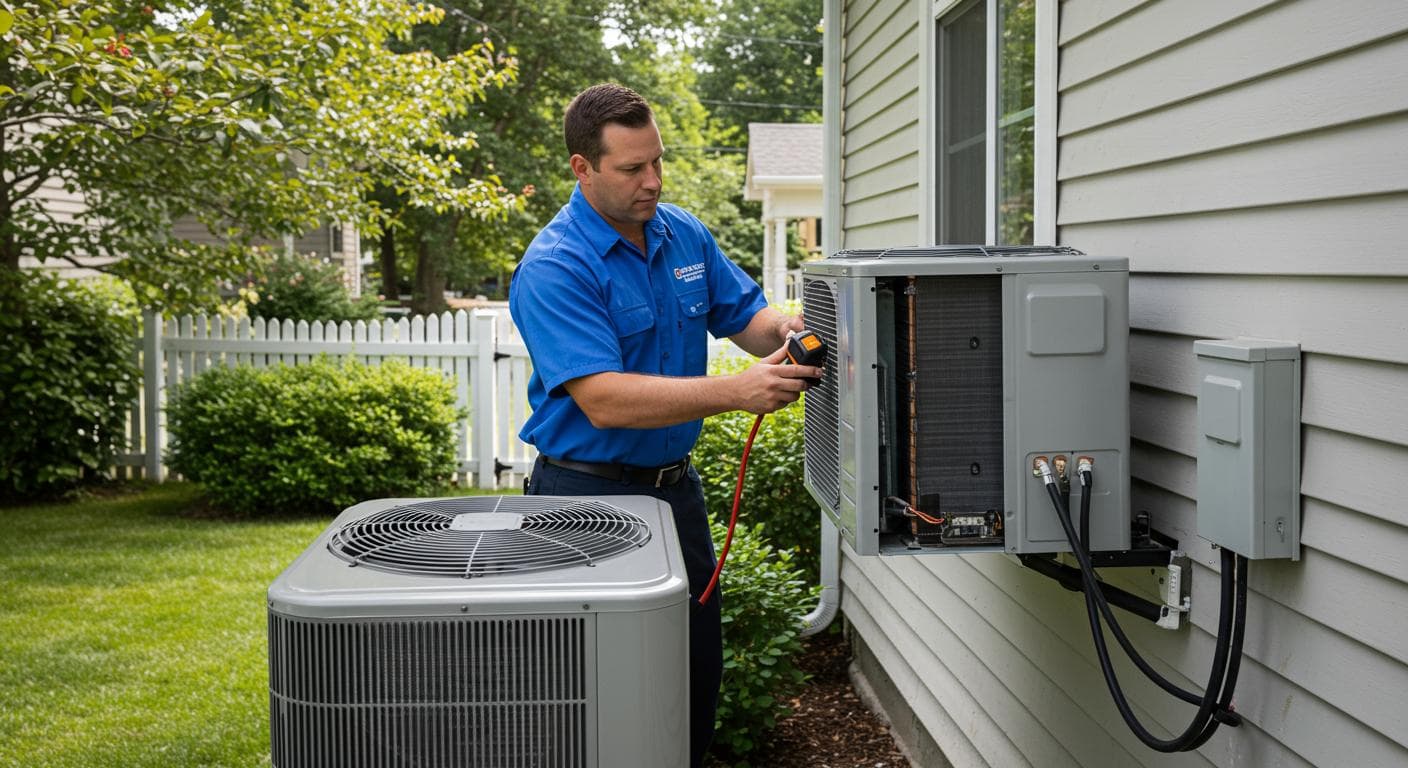
HVAC Tucson: Contractors Who Understand Desert Cooling Loads
Tucson's climate demands more from HVAC systems than almost any other city in the United States. Summer temperatures routinely exceed 105 degrees Fahrenheit, and because Tucson sits at 2,400 feet elevation in the Sonoran Desert, the sun angle and UV intensity drive radiant heat loads into homes that straightforward temperature readings do not fully capture. An HVAC system sized for a Tucson home needs to account for solar heat gain through poorly insulated roofs and west-facing windows, duct losses through attics that regularly reach 140 to 160 degrees in summer, and the sudden humidity load that arrives with Arizona's monsoon season each July. HVAC contractors in Tucson who use Manual J load calculations rather than rule-of-thumb sizing produce systems that are more efficient, last longer and keep the home actually comfortable on peak summer days. An oversized system short-cycles, failing to dehumidify during monsoon and wearing out equipment faster. An undersized system runs continuously on peak days and cannot hold setpoint. Getting sizing right in Tucson is not a detail, it is the job. Contractor Palace matches you with Tucson HVAC contractors who do the calculation correctly and have the Southern Arizona field experience to install and commission systems for peak desert performance.
Best HVAC Companies in Tucson: Independent Local Companies
The best HVAC companies in Tucson are family owned businesses built on community trust, not national franchise chains dispatching technicians from a call center in another state. When your AC fails at 4pm on a 110-degree August afternoon, the phone call you want to make is to a Tucson business whose team lives in this community and whose reputation depends on helping you right now. Contractor Palace matches Tucson homeowners with HVAC companies that operate that way, family owned businesses with a local team, a local phone number and the kind of community accountability that comes from doing business in one place for years.
Check license status, insurance coverage and customer reviews for every HVAC company you consider. Watch for the trust traps that show up during peak season: oversized system quotes, unnecessary add-ons and vague warranties.
Desert Cooling Loads: What Makes Tucson HVAC Different
The Sonoran Desert creates an HVAC environment dominated by radiant solar heat rather than just ambient air temperature. A home in Tucson on a 110-degree day is contending with attic temperatures that can exceed 150 degrees, roof surfaces that become heat radiators into the living space below and west and south facing walls that absorb solar radiation throughout the afternoon. Standard cooling load estimates developed for milder climates routinely underestimate the actual peak demand in a Tucson home. This is why working with a Tucson HVAC contractor who performs a proper Manual J load calculation is worth the time and money upfront.
Duct design is equally important in Tucson. Many older Tucson homes have duct systems routed through unconditioned attic space. In summer, those ducts pass through 140-plus-degree air. Even well-insulated ductwork loses a significant percentage of conditioned air to heat gain in that environment. A Tucson HVAC contractor performing a system replacement should always assess duct condition, insulation levels and layout as part of the project scope. In some cases, relocating ducts to conditioned space or adding attic insulation to reduce attic temperature is more cost-effective than simply installing a larger and more powerful cooling system. Contractor Palace matches you with Tucson HVAC contractors who approach the system as a whole rather than swapping equipment in isolation.
Monsoon Humidity in Tucson HVAC Systems
Heat Pumps vs Straight-Cool Systems in Tucson
Tucson's mild winters create a case for heat pump technology that does not exist in colder climates. Traditional heat pumps struggle to maintain efficiency when outdoor temperatures drop below freezing because the refrigerant cycle must work harder to extract heat from cold outdoor air. In Tucson, where winter lows rarely fall below the mid-20s and average January lows are in the mid-40s, a heat pump operates in its efficient range for the vast majority of heating-season hours. A heat pump in Tucson can deliver three to four units of heating energy for every unit of electricity consumed during typical winter conditions, making it substantially more efficient than a gas furnace or straight-cool air handler with electric strip heat.
Variable-speed heat pumps, often called inverter-driven systems, carry a higher upfront cost but deliver meaningful advantages in Tucson's climate. Variable-speed compressors modulate output to match the actual load rather than cycling fully on and off, which improves dehumidification during monsoon, reduces temperature swings in the living space and reduces the peak power demand that drives up utility bills under time-of-use rates. APS and TEP both offer time-of-use rate structures that reward shifting electricity consumption away from summer afternoon peaks. A variable-speed HVAC system that can pre-cool a home in the morning before peak rates begin provides meaningful bill reduction for Tucson homeowners on those rate structures. Your matched Tucson HVAC contractor should discuss rate structures and system operating strategies as part of any replacement consultation.
HVAC Services and Costs in Tucson
Evaporative Cooling in Tucson's Desert Climate
Evaporative cooling, also called swamp cooling, works by drawing outside air across water-saturated pads, cooling it through evaporation and circulating that air through the home. In a true desert climate with low humidity, evaporative coolers can drop indoor temperatures by 15 to 25 degrees at a fraction of the electricity cost of a refrigerant-based air conditioning system. The critical limitation is humidity: evaporative cooling does not work well when outdoor relative humidity is above 40 to 50 percent because the air is already carrying too much moisture to accept additional evaporation.
In Tucson, this creates a split-season problem. Pre-monsoon, from April through late June, Tucson's humidity is desert-dry and evaporative cooling performs well. During monsoon, from July through September, an evaporative cooler may struggle to keep up and can make the house feel more humid than the outside. Many Tucson homeowners operate a dual system: an evaporative cooler for the pre-monsoon dry season and a refrigerant-based system for monsoon months. A Tucson HVAC contractor familiar with this approach can configure a dual-system setup or recommend a two-stage evaporative cooler with a bypass mode. The operating cost advantage of evaporative cooling during the dry season is real and significant enough that many Tucson homeowners find the dual-system investment worthwhile.
How to Choose a Tucson HVAC Contractor and Avoid Common Mistakes
Require a Manual J load calculation before system sizing
Any Tucson HVAC contractor quoting a replacement based on square footage alone or rule of thumb is skipping the step that determines whether the system will actually work in Tucson's climate. Manual J considers insulation levels, window area, duct location and orientation, not just floor area.
Check Arizona ROC license status
Arizona HVAC contractors must hold a license from the Arizona Registrar of Contractors (ROC). Verify the license number is active and in good standing at roc.az.gov before signing any contract. Independent local contractors carry the required bonding and insurance.
Ask about SEER2 efficiency and utility rebates
TEP and APS both offer rebates for high-efficiency system replacements that can reduce out-of-pocket cost by $300 to $1,500. A Tucson HVAC contractor who stays current with utility rebate programs can apply for the rebate on your behalf and reduce your net cost.
Evaluate duct condition as part of any replacement quote
Replacing equipment without addressing failing ducts in a Tucson attic is like putting new tires on a car with a broken axle. Ask every bidding contractor to assess duct insulation condition and include duct remediation in the quote if the ducts are undersized or deteriorated.
HVAC Contractors Serving the Tucson Metro Area
Tucson HVAC contractors matched through Contractor Palace serve the greater Tucson metro area including Marana, Oro Valley, Sahuarita, Green Valley and surrounding communities in Pima County. Local contractors with established Tucson operations know the common construction types in each neighborhood, the local permit requirements and the nearest supplier for parts and equipment. When an emergency repair comes up mid-monsoon, a contractor with an established local operation can respond faster than a company dispatching from across the metro.
Frequently Asked Questions
How much does AC replacement cost in Tucson?
A standard efficiency central AC replacement for a typical Tucson home runs $4,500 to $8,500 installed. High-efficiency systems rated 16 SEER2 or above run $7,000 to $13,000. Heat pump systems run $6,000 to $12,000. Variable-speed systems run $10,000 to $18,000. TEP and APS rebates can reduce net cost by $300 to $1,500 for qualifying high-efficiency units.
Is a heat pump a good choice for Tucson?
Yes, Tucson's mild winters make heat pumps an excellent choice. Tucson rarely sees temperatures cold enough to push a heat pump into the less-efficient range. A heat pump delivers 3 to 4 units of heating energy per unit of electricity in Tucson winter conditions, making it significantly more efficient than electric resistance heat. Variable-speed heat pumps also improve dehumidification during monsoon.
Should I get an evaporative cooler or central AC in Tucson?
Many Tucson homeowners run a dual-system approach: an evaporative cooler for the dry pre-monsoon season and a refrigerant-based AC for monsoon months when humidity is too high for evaporative cooling to work well. Evaporative cooling has a significant operating cost advantage during dry season. A Tucson HVAC contractor can assess whether your home is set up for dual-system operation.
What SEER rating should I look for in Tucson?
Given Tucson's extreme cooling season length, higher SEER2 ratings pay back faster here than in cooler markets. A 16 SEER2 system versus a 14 SEER2 baseline can save several hundred dollars per year in a Tucson home that runs AC for six-plus months. Utility rebates often target 16 SEER2 and above, improving the payback even further.
How often should I service my HVAC system in Tucson?
At minimum, have a Tucson HVAC contractor perform a tune-up and coil cleaning every spring before the cooling season begins. Desert dust is hard on HVAC equipment, clogging coils and filters faster than in cleaner-air markets. If your home has pets or heavy dust, a mid-season filter check is also worthwhile. Neglected maintenance in Tucson's demanding climate shortens equipment life significantly.
Need an HVAC contractor in Tucson? Get matched free.
Tell us about your system. We match you with an independent Tucson HVAC contractor who does proper load calculations and knows Southern Arizona's climate.
Get my free Tucson HVAC quotearrow_forward