Smart Home & Security near me Smart Home & Security, local.
Security camera installation, smart lock setup, alarm systems, video doorbells and full smart home integration across Ohio. Our certified technicians program and test everything before they leave.
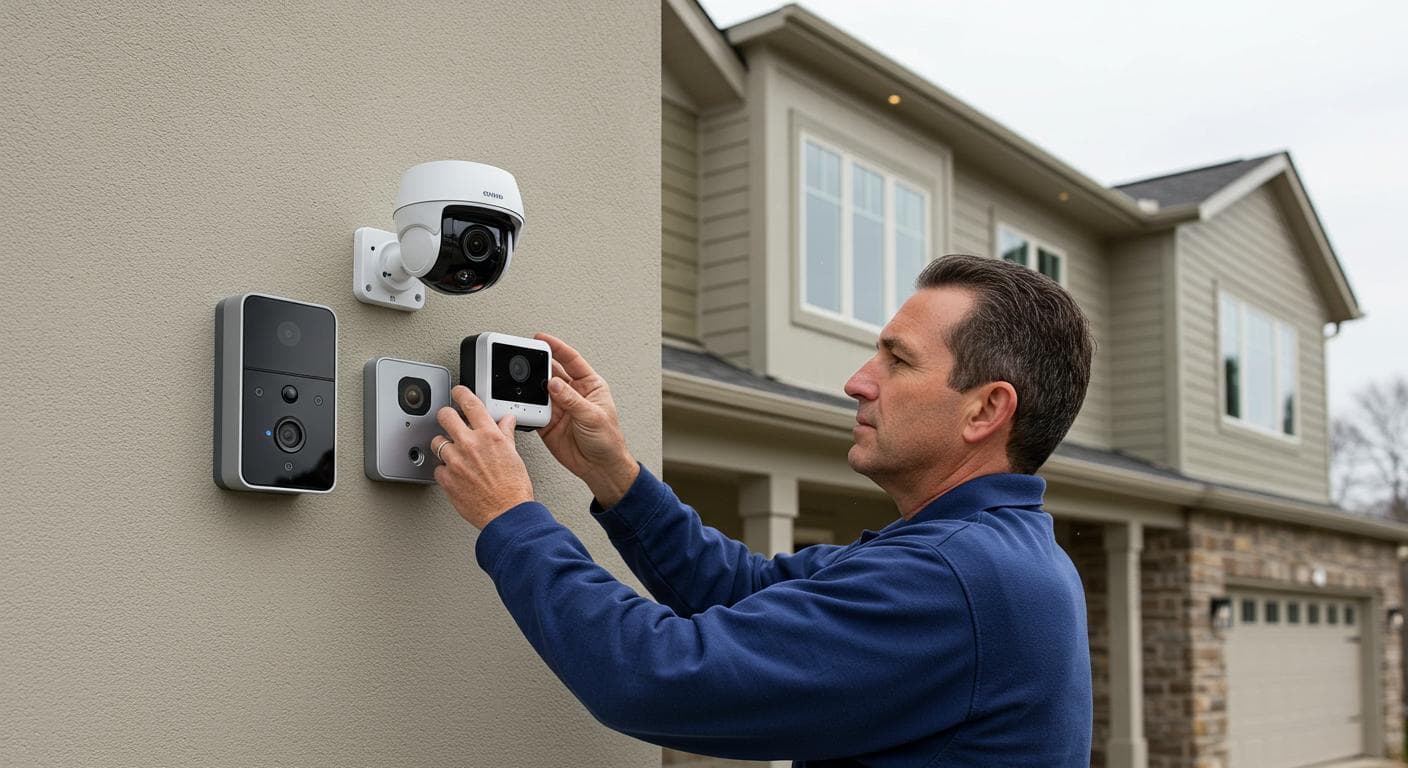
What is smart home & security?
Smart home and security system installation integrates technology into your Ohio home to improve security, convenience, energy efficiency and remote monitoring capabilities. From a single video doorbell to a fully automated home with integrated lighting, climate, locks and security cameras, smart home technology has become accessible and genuinely useful for Ohio homeowners.
Smart home services include security camera system installation (wired and wireless), video doorbell installation (Ring, Nest, Arlo), smart lock installation and configuration, smart thermostat installation (Nest, Ecobee, Honeywell), whole-home audio system setup, automated lighting control, smart smoke and CO detectors and full smart home hub integration (Google Home, Amazon Alexa, Apple HomeKit).
Ohio's security concerns vary by area, Cleveland, Columbus and Toledo have higher property crime rates in certain neighborhoods, making security cameras and monitored alarm systems a strong deterrent. Smart thermostats are particularly valuable in Ohio's climate where heating and cooling costs are significant, Nest and Ecobee learning thermostats can reduce HVAC costs by 10-15% in Ohio homes.
Professional installation ensures cameras are positioned for maximum coverage with correct angles, app configuration is completed and tested and all devices are integrated into a single control system. DIY installs often have gaps in coverage, notifications that never work or apps that were never properly configured.
What homeowners should know.
Smart Home Technology for Ohio Homeowners
Smart home systems range from a single video doorbell to a fully integrated setup controlling security, lighting, HVAC, locks and entertainment across the whole house. The right starting point depends on what problems you're actually trying to solve, not what's featured on a display shelf.
Video doorbells (Ring, Nest, Arlo) are the highest-adoption device in Ohio homes right now. They're straightforward to install and provide immediate value: package theft prevention and the ability to see and speak with visitors remotely. Professional installation ensures the device is powered correctly (hardwired doorbell wiring vs. battery vs. plug-in transformer), properly aimed and integrated with your phone and existing doorbell chime.
Security System Options
Professionally monitored security systems (ADT, Vivint, Brinks) provide 24-hour monitoring with police dispatch capability. The tradeoffs are monthly fees ($30 to $70 per month) and multi-year contracts with cancellation penalties. Self-monitored systems (SimpliSafe, Ring Alarm, Nest Secure) eliminate monthly fees and contracts but put response responsibility on you. For Ohio homeowners in higher-risk neighborhoods, professional monitoring adds real protection. For lower-risk areas, self-monitored with video coverage at entry points is often sufficient.
Smart Locks and Access Control
Smart locks replace standard deadbolts with keypad, app or voice-controlled access. Popular Ohio-market brands include Schlage Encode, Kwikset Halo and Yale Assure. Professional installation ensures the lock is properly aligned (critical for reliable operation) and integrated with your home's Wi-Fi or smart home hub. Access codes can be set for cleaners, dog walkers or family members without cutting physical keys.
Smart Lighting
Smart lighting (Lutron Caseta, Philips Hue, Kasa) can be implemented at the switch level (replacing standard switches with smart switches) or at the bulb level (smart bulbs in existing fixtures). Switch-level implementation works with any bulb and survives roommate or family member error better than smart bulb setups. Professional installation of smart switches ensures proper wiring (smart switches require a neutral wire that some older Ohio homes lack) and multi-switch configuration in 3-way circuits.
HVAC and Smart Thermostats
Smart thermostats (Ecobee, Google Nest, Honeywell T9) deliver real energy savings in Ohio's heating-dominated climate. Ecobee's remote sensors address the common Ohio problem of upstairs bedrooms that run 5 to 8 degrees warmer than the thermostat location. Installation is straightforward in most cases but requires confirming your HVAC system's wiring configuration first. Older Ohio homes with gravity-fed hot water heat or steam radiators require a different approach.
Professional Installation vs. DIY
Simple devices (doorbell, single smart bulb, plug-in smart outlet) are straightforward DIY. Anything involving electrical panel work, low-voltage wiring runs through walls, hardwired outdoor cameras or multi-device integration across platforms benefits from professional installation. Our installers ensure compatibility across your chosen ecosystem and eliminate the troubleshooting that makes DIY smart home setup frustrating.
### Monitored vs. Self-Monitored Security: The Real Ohio Tradeoff
This is the central decision for Ohio homeowners setting up a security system and the answer depends on your neighborhood, lifestyle and budget rather than one option being universally better.
Professionally monitored systems (ADT, Vivint, Brinks, Guardian) employ a 24-hour dispatch center. When your alarm triggers, the monitoring center calls you first, then dispatches police if they cannot reach you or if you confirm an intrusion. The practical value: if you are asleep, traveling or unable to check your phone, someone is watching. The cost: monthly fees run 30 to 70 dollars per month depending on the service level and most contracts run 24 to 36 months with cancellation penalties.
Ohio response times matter here. Columbus, Cleveland and Cincinnati police respond to residential burglar alarms in 20 to 45 minutes on average during busy periods. Akron and Toledo metro areas have similar response statistics. Professional monitoring dispatches to a real call center instantly but the police response time at your address is the same regardless of whether the call came from monitoring or your phone.
Self-monitored systems (SimpliSafe, Ring Alarm, Nest Secure) send push notifications to your phone when sensors trigger. You watch the camera feed and call 911 yourself. There are no monthly fees for the base alarm function (though camera cloud storage and professional monitoring add-ons are available). The limitation: you must be available and attentive to act. At 3am in a deep sleep or in a region with poor cell signal, self-monitoring requires you to be the responder.
A practical middle path: self-monitored alarm with professional monitoring available as an optional add-on. SimpliSafe and Ring both offer monitoring starting around 10 to 20 dollars per month with no long-term contract, which provides monitoring-on-demand without the 3-year commitment of legacy providers.
For Ohio homeowners in lower-crime suburban areas, a well-placed camera system with video doorbell and self-monitoring provides meaningful deterrence and documentation without ongoing subscription costs. For properties in higher-crime urban neighborhoods in Cleveland, Columbus or Toledo, professional monitoring with quick dispatch capability is worth the monthly cost.
### Camera System Planning: What Ohio Homes Actually Need
Camera placement is where professional installation earns its value. A poorly placed security camera provides footage of the wrong area, is easily avoided by someone who notices it or captures insufficient detail to be useful for identification.
The minimum effective camera layout for an Ohio single-family home: one camera covering the front door and driveway approach, one covering the back door or rear access point, one covering the gate or side yard access that cannot be seen from the front. This three-camera setup covers the primary ingress points. Garage is the fourth priority if detached or if the garage has a service door.
Camera specifications that matter for Ohio conditions: outdoor cameras need to operate reliably from negative 10 degrees Fahrenheit through 100 degrees Fahrenheit. Ohio winters and summers both test cameras. Look for IP66 or IP67 weather resistance ratings. Resolution should be 1080p minimum for outdoor cameras, 2K (2560x1440) or 4K provides meaningfully better face and license plate detail at a modest price premium.
Color night vision (cameras with added white light for color low-light footage) significantly outperforms standard infrared night vision for identification purposes. Standard IR cameras produce black-and-white footage that makes identifying clothing color, vehicle color or facial features difficult. Brands like Arlo Pro 4, Reolink Duo and Google Nest Cam offer color night vision in their current product lines.
Local storage (NVR with hard drive or SD card in cameras) versus cloud storage is a practical decision for Ohio. Cloud storage provides off-site backup but requires ongoing subscription fees (10 to 30 dollars per month per camera for most services). Local NVR storage is a one-time hardware cost and keeps footage accessible without a subscription. The risk with local-only storage: if a burglar takes the NVR recorder, footage is lost. Hybrid systems that write to both local storage and cloud for recent events address this.
### Smart Lock Selection and Installation Details for Ohio Homes
Smart lock models differ significantly in how they communicate, how they are powered and what integration they support. Getting the wrong lock for your infrastructure wastes money.
Wi-Fi smart locks (Yale Assure Wi-Fi, Schlage Encode Plus, Kwikset Halo) connect directly to your home network. No hub required. App control works immediately after setup. The downside: Wi-Fi chips consume more battery power, requiring more frequent battery changes (4 to 8 months on a set of AA batteries versus 12 to 18 months for Z-Wave locks). Wi-Fi locks are the right choice for simple setups without existing smart home ecosystems.
Z-Wave and Zigbee smart locks (Schlage Connect, Yale Z-Wave, Kwikset SmartCode) require a compatible hub (SmartThings, Hubitat, Amazon Echo with a Zigbee hub built in) but consume less power and integrate deeply into broader smart home scenes and automations. If you already have a SmartThings or similar hub, a Z-Wave lock adds significantly more automation capability.
Thread and Matter-compatible locks are the newest protocol. Matter enables direct communication between devices across ecosystems. Google Home, Apple HomeKit and Amazon Alexa all support Matter, which means a Matter lock works across platforms without vendor lock-in. This is the future-proof choice but the product selection is still limited in 2026.
Ohio professional installation ensures proper door alignment before mounting. Smart locks are precision devices: a door that sticks, binds or has a misaligned strike plate will cause electronic lock failures. A good installer adjusts the door and frame as needed, aligns the strike plate and confirms smooth mechanical operation before programming the electronics.
### Smart Thermostat Performance in Ohio's Climate
Ohio's heating-dominated climate makes smart thermostat performance particularly meaningful. The state averages 5,000 to 6,000 heating degree days annually, meaning your furnace works hard 5 to 6 months of the year. A thermostat that learns your schedule and setback patterns can reduce heating run time by 10 to 20 percent in a typical Ohio home.
Ecobee remains the technically superior choice for multi-zone temperature management. The included remote sensors detect occupancy and temperature in rooms other than the thermostat location. In a typical two-story Ohio colonial where the thermostat is on the first floor and the upstairs bedrooms run 5 to 8 degrees warmer, this matters significantly. Ecobee uses the average of occupied sensor readings to control the system, bringing upstairs bedrooms to comfortable temperature without overcooling the first floor.
Google Nest Learning Thermostat takes a different approach: it learns your manual adjustments over several weeks and builds a schedule automatically. Less setup, less configuration. It does not use remote sensors by default but integrates with Nest Temperature Sensors as an add-on. Nest works best in homes with relatively consistent occupancy patterns.
Honeywell T9 (now Resideo) uses remote sensors like Ecobee and is compatible with most HVAC systems including older Ohio furnaces that have fewer thermostat wires. Compatibility is the critical variable: confirm your HVAC system has a C-wire (common wire) available before purchasing any smart thermostat. Most Ohio HVAC systems installed after 2000 have a C-wire. Older systems may need a C-wire adapter kit or an HVAC visit to add one.
### Common Smart Home Installation Mistakes in Ohio
Placing outdoor cameras on the soffit overhang pointing down. This angle captures foot movement well but misses face level for anyone who tilts their head down. A slight forward tilt toward head height is generally more useful for identification footage.
Installing smart locks without adjusting the door first. A sticky or misaligned door becomes a reliability problem that looks like a technology failure. Every professional installer checks door operation before mounting.
Building a smart home ecosystem without planning for Wi-Fi dead zones. Smart home devices require reliable wireless coverage throughout the home. Ohio homes with thick plaster walls (common in pre-1950 Cleveland, Columbus and Cincinnati homes) and brick exteriors have notorious dead zones. A mesh Wi-Fi system (Eero, Google Nest Wi-Fi, Orbi) before adding smart devices is the right infrastructure sequence.
### Mini FAQ
**Do Ohio municipalities require permits for security camera installation?** External cameras mounted on the building do not typically require permits in Ohio. Hardwired low-voltage systems (running cable through walls, installing network drops) may require a low-voltage permit in some municipalities. Your installer handles this determination.
**What happens to my smart home devices if the internet goes down?** Most smart locks retain local access: keypads and physical keys continue to work. Cameras with local NVR storage continue recording. App control and remote access require internet. Systems designed for Ohio's ice storm power outage scenarios should have a battery backup plan for the router and key hubs.
**Can I use Google Home and Amazon Alexa devices together?** Yes. Matter-compatible devices work across both ecosystems. Older devices are typically limited to one ecosystem. A professional installer can assess your existing devices and recommend a hub strategy that bridges them where possible.
**How long does a full smart home installation take for a typical Ohio home?** A standard installation covering a video doorbell, 4 outdoor cameras, 2 smart locks and a smart thermostat typically takes 4 to 8 hours for a professional crew. All devices are mounted, wired where applicable, connected to the network and fully configured in the apps before the technician leaves.
Columbus Home Security Companies: Free Quote Guide
Home security companies in Columbus Ohio offer free quote consultations for camera systems, smart locks, alarm panels and whole-home automation. When comparing quotes from Columbus home security companies, ask specifically what is included in the monthly monitoring fee vs the equipment cost. Many home security companies bundle equipment at low upfront cost in exchange for 24 to 36-month contracts. Get at least two free quotes before signing.
Smart home security installation in Ohio covers Ring and Nest camera systems, ADT and Vivint monitored alarm panels, smart door locks (Schlage, Kwikset), video doorbells and smart thermostat integration. Columbus homeowners can expect installation costs of $200 to $800 for a basic system and $1,000 to $3,000 for a full smart home integration including cameras, locks and lighting.
Everything a job covers.
How to hire a smart home & security near you.
Describe your smart home or security project, specific devices or starting from scratch, with your Ohio address
Tech assessment visit to plan camera placement, network requirements and device compatibility
All devices mounted, wired (for wired systems) and connected to your home network
Apps configured on your smartphone, alerts, schedules and automations set up per your preferences
Full walkthrough of system operation, you're trained on every feature before the tech leaves
Smart Home & Security cost near you.
Prices vary by scope and city. You get a firm quote after describing the job, free, no obligation.
* US average estimates. Final pricing confirmed before any work begins.
Why hire a professional near you.
System-agnostic recommendations, we tell you what platform works best for your needs, not what earns us the most margin
Camera placement expertise, optimal angles for coverage with no blind spots
Full app configuration and testing before leaving, no figuring it out yourself
12-month phone support included, call us when the app update confuses you
Network assessment included, smart devices need solid WiFi coverage to work reliably
Get matched instantly.
Describe the job
Tell us about your smart home & security project: scope, urgency and your zip code.
We match & dispatch
We find the best available verified pro in your area. No bidding wars, no picking from a list.
Get your free quote
Your pro reviews the job and sends a quote. You only pay once you approve the work.
How to choose the best smart home & security company.
Smart home installation quality is almost entirely about the technician's expertise and patience. Ask specifically: 'Will you configure the apps and set up automations during the install or just mount the hardware?' A tech who only mounts hardware leaves you struggling with setup.
For security camera systems, ask about camera resolution (minimum 1080p for outdoor cameras), storage method (local NVR vs cloud) and night vision capability. Ohio homes benefit from cameras with color night vision, not just standard infrared, for useful nighttime footage.
Companies like ADT and Vivint operate in Ohio with monitored contracts, these can be excellent for those wanting professional monitoring but come with multi-year contracts. Contractor Palace offers self-monitored systems without contracts as an alternative.
Skip the comparison shopping. Contractor Palace pre-vets every pro and dispatches the best match, no browsing directories, no bidding wars.
Signs you need this service.
No security cameras or alarm on a property where you want visibility and deterrence
Moving into a new Ohio home and wanting to set up security before settling in
Package theft from doorstep, video doorbell with motion alert is the targeted solution
HVAC bills too high, smart thermostat often pays for itself in under 2 years in Ohio's climate
Managing a rental property in Ohio and wanting remote access control with smart locks
Elderly family member living alone, smart home monitoring provides peace of mind
Existing security system outdated, not app-controlled or from a company no longer in business
Smart Home & Security Services by Ohio City
We serve all major Ohio markets. Choose your city for local pricing, availability and verified pros near you.
Your privacy is protected
We never expose contractor names, business names or direct contact info on our platform. Communication runs through Contractor Palace until your pro is assigned and the work begins, at which point you get direct contact for your pro. It protects both you and the pro.
Why homeowners trust us.
Smart Home & Security FAQ.
What smart home platforms do you work with?
Google Home, Amazon Alexa, Apple HomeKit, Ring, Nest, ADT, SimpliSafe and more. We recommend the best ecosystem for your home and devices.
Do I need monthly monitoring fees?
Not necessarily. Many camera and alarm systems work without subscriptions. We'll explain the options, monitored vs self-monitored, so you can choose.
Can you integrate with an existing alarm system?
Usually yes. We assess your existing system and either integrate new devices or recommend an upgrade path.