Framing & Structural near me Framing & Structural, local.
Room additions, load-bearing wall removal, beam installation and new construction framing across Ohio. Our structural pros work with architects and engineers to deliver code-compliant, inspected results.
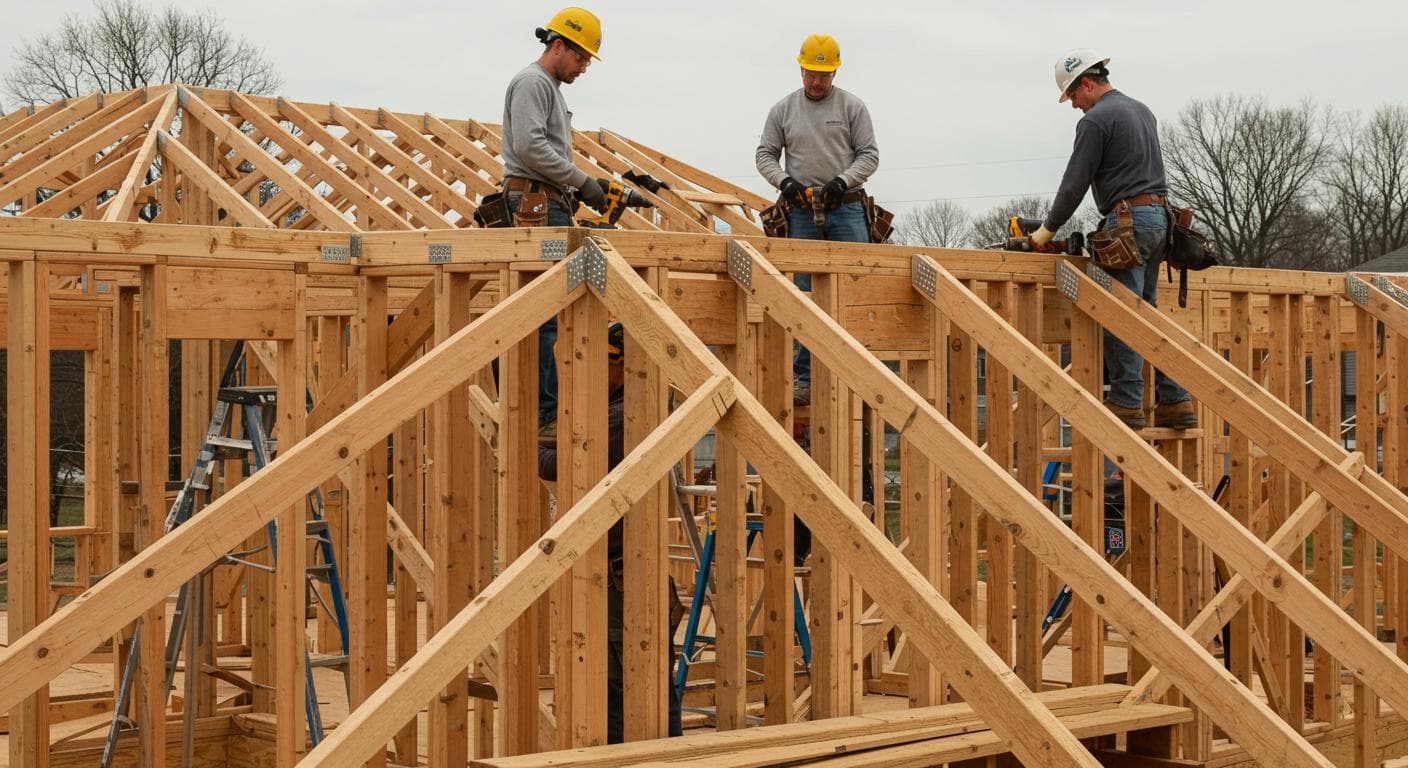
What is framing & structural?
Framing and structural work is the backbone of any construction or remodeling project, it's the skeleton that determines your home's layout, strength and long-term stability. In Ohio, structural framing work requires licensed contractors and in most cases structural engineering review, especially for load-bearing modifications.
Services include new room addition framing, load-bearing wall removal with proper beam installation, structural beam replacement (often needed in older Ohio homes with deteriorating sill plates), garage and outbuilding framing, wall framing for basement finishing, second-story additions and structural repairs after water or pest damage.
Ohio's older housing stock presents common structural challenges: settling foundations in Columbus's clay soil, deteriorated sill plates in Cleveland's older homes from moisture exposure and undersized beam spans in mid-century open-plan conversions. Every structural project on our platform involves a licensed contractor and structural engineer review where required by Ohio code.
Never attempt to remove a wall in an older Ohio home without professional assessment, the consequences of removing an unidentified load-bearing wall can be catastrophic and expensive to repair.
What homeowners should know.
Framing and structural work is the phase of construction that determines everything else, the layout you'll live with, the walls that can or cannot be removed in the future and the structural integrity of your Ohio home for decades. Every framing decision made during construction or renovation has lasting consequences.
Load-bearing wall removal is the most requested structural modification Ohio homeowners ask for and the most dangerous if done incorrectly. Any wall parallel to the floor joists above, walls stacked on floors above and walls near the center of the home's span are candidates for load-bearing status. A structural engineer stamps the beam sizing calculation, an LVL (laminated veneer lumber) beam from manufacturers like Weyerhaeuser or a steel beam for longer spans, specifying the exact dimensions required to carry the load safely. Do not hire any contractor who removes a wall without engineering drawings.
Room additions framing in Ohio must account for the existing foundation and how the new framing ties into the existing structure. Platform framing (each floor framed independently) is standard in Ohio residential construction. Engineered lumber products, LVL beams, I-joists and rim board, are increasingly specified for additions because of their superior dimensional stability compared to dimensional lumber, which can cup and bow in Ohio's humidity cycles.
Common Ohio framing challenges: older homes in Cleveland and Columbus often have deteriorated sill plates and rim joists from decades of moisture exposure, these must be replaced before any addition framing begins. Mid-century ranch homes frequently have undersized rafters for modern snow loads; Ohio's climate zone requires careful snow load calculation on any roof framing work.
For new garage framing and outbuilding framing, engineered trusses ordered from truss fabricators deliver faster installation and superior span capability compared to stick-framed roofs. Truss lead times in Ohio are typically 2 to 4 weeks, which should be factored into your project timeline.
### What Residential Structural Framing Actually Covers
Structural framing is the skeleton of a building, floor systems, wall framing, roof framing and the connections between them. Residential structural framing work in Ohio covers new construction framing, additions, load-bearing wall removal, beam installation, floor joist sistering and structural framing modifications needed to reconfigure existing space.
The importance of proper structural framing cannot be overstated. Every element in a wood-framed house, the roof, the floors, the exterior cladding, depends on the framing being correct. A miscalculated beam or an improperly sized header over an opening does not always fail immediately. It deflects slowly over years, causing cracked drywall, sticking doors, bouncy floors and, in the worst cases, structural failure. These problems cost far more to fix after the fact than they would have cost to engineer correctly upfront.
### Load-Bearing Wall Removal: What It Involves
Load-bearing wall removal is one of the most commonly requested structural framing modifications in Ohio home renovation. Open floor plans are popular and most Ohio homes from the 1950s through 1990s have structural walls in inconvenient locations. Removing them the right way requires an engineer-stamped plan, a permit and a licensed contractor to execute the work.
The process: a structural engineer determines the beam size needed to carry the load formerly supported by the wall. A temporary support wall goes up to carry the floor or roof above while the permanent wall comes out. The beam, typically an LVL (laminated veneer lumber) or steel I-beam depending on the span, goes in at the correct height, properly seated on posts or columns that carry the load down to the foundation. The temporary wall comes down. Inspections happen at each stage.
Homeowners who remove load-bearing walls without engineering and permits in Columbus, Cleveland or Cincinnati create problems that surface at home sale time. An unpermitted structural modification is a material defect that must be disclosed. The remedy is often tearing out finish work to prove the beam is correct, which is more expensive than doing it right the first time.
### Structural Framing for Additions and New Construction
Additions require framing that ties into the existing structure correctly. This means matching floor system heights, connecting to the existing roof framing at the right angle and accounting for the foundation type under the addition. A framing contractor doing an addition needs to understand the original construction, older Ohio homes were not always built to tolerances that make tying in clean.
For new construction framing, the sequence is floor system first (rim joists, floor joists, subfloor), then exterior wall plates and studs, then interior bearing walls, then the roof framing system. Roof framing choices, stick framing vs. pre-engineered trusses, affect both cost and the flexibility of the attic space. Trusses are faster and cheaper for simple rooflines but limit attic storage and complicate future modifications. Stick framing takes more skilled labor but is more adaptable.
### Structural Framing Modifications for ADA-Compliant Design
ADA compliant structural framing modifications come up most often in commercial renovation but also appear in residential projects where accessibility is a goal, doorway widening, accessible bathroom conversions and ramp installations all touch framing. Widening a doorway from a standard 32-inch opening to a 36-inch accessible opening often requires a larger header, especially if it is in a load-bearing wall.
In Ohio commercial construction, ADA compliance is a code requirement on any substantial renovation. The structural framing work that supports accessibility improvements, wider openings, reinforced blocking for grab bars, structural support for platform lifts, needs to be engineered and inspected. Contractors who do commercial work in Ohio know this. Those who only do residential should acknowledge when a project requires commercial-grade documentation.
### Framing Cost Ranges in Ohio
Load-bearing wall removal with beam installation, single span: $3,500 to $9,000 depending on beam size, span and whether a structural engineer is included in the contractor's quote or separate. New addition framing only (labor, no materials): $12 to $20 per square foot for the framing scope. Full framing package on a new construction home, including materials and labor: $18 to $30 per square foot depending on design complexity and the Columbus vs. rural Ohio labor market.
Floor joist sistering to address bounce or deflection: $2,000 to $6,000 for a typical basement job depending on how much of the floor system is affected.
### Signs Your Home Has a Structural Framing Problem
Doors that stick or will not close correctly, especially in multiple locations at once, suggest the frame has moved. Drywall cracks above door and window corners are common in Ohio homes with settling foundations, but they can also indicate a beam that is over-deflecting. A floor that bounces noticeably when you walk across it has undersized or damaged floor joists.
Sagging or wavy roof lines are visible from outside the home. In Ohio homes from the 1940s and 1950s, roof framing that was built to codes no longer in use sometimes does not meet current span requirements. This matters if you are adding rooftop equipment, solar panels or a roof deck.
### Why Choosing the Right Residential Structural Framing Contractor Matters
Comprehensive structural framing work requires experience reading engineering drawings, working with building inspectors and understanding how loading paths through a structure work. Not every general framing crew has this. For structural framing needs that involve load-bearing modifications, ask specifically whether they have worked with structural engineers on similar projects and how many they have completed.
Ask for permit history in your city. An experienced Ohio framing contractor has pulled permits in Columbus, Cleveland, Cincinnati or the relevant local jurisdiction before. They know the inspection checkpoints and how to stage work to avoid delays. A crew that is new to the jurisdiction and learning the local inspection process on your project is a risk you do not need to take.
### What Drives Framing and Structural Work Cost in Ohio
Structural framing is one of the few construction trades where the cost is almost entirely labor-driven. Lumber prices fluctuate nationally but the framing crew's skill, speed and familiarity with Ohio code determines whether your project comes in on budget or not.
Lumber costs: framing lumber prices peaked in 2021 and have moderated but remain volatile. In 2024 to 2025, standard SPF (spruce-pine-fir) dimensional lumber runs 0.60 to 0.90 dollars per linear foot for 2x4 and 1.20 to 1.80 dollars per linear foot for 2x6. Engineered lumber, LVL beams for headers and ridges and TJI floor joists, is priced by the specific member and load calculation and typically costs 2 to 5 times more than dimensional lumber of similar size. The premium is worth it for spans over 10 feet where engineered lumber's consistency and dimensional stability prevent future deflection and squeaking.
Labor rates: framing crews in Columbus, Cleveland and Cincinnati charge 5 to 9 dollars per square foot for new construction framing and 15 to 30 dollars per square foot for complex remodel framing where every cut works around existing structure. The remodel premium reflects the time spent cutting into existing walls, verifying load paths and coordinating with plumbing and electrical that's already in the walls.
Structural engineering: any change to a load-bearing wall, modification of an existing header or addition of a new window or door opening in a load-bearing wall requires a structural engineer to specify the beam size and connection details. Structural engineering for a single residential modification costs 600 to 1,800 dollars. It is money that protects every dollar invested in the project and satisfies the building inspector.
Permit and inspection fees: framing inspection is part of every building permit in Ohio. Columbus charges 100 to 400 dollars for permits covering structural work depending on project valuation. Cleveland and Cincinnati are similar. Inspectors look at nailing patterns, header sizes, stud spacing, bearing points and hurricane tie or hold-down hardware requirements.
### Load-Bearing vs Non-Load-Bearing: Understanding the Difference
This is the question every Ohio homeowner asks when they want an open floor plan and the answer requires more than eyeballing a wall.
A load-bearing wall transfers the weight of the structure above it, floor joists, roof rafters or upper-story walls, down through the framing to the foundation. Removing or modifying one without engineering creates risk of structural failure.
Signs a wall may be load-bearing: it runs perpendicular to floor joists (check the basement or crawlspace), it aligns with a wall or beam directly below on the next floor down, it supports visible ridge board framing above or it is located near the center of a wide house.
Signs a wall is probably non-load-bearing: it runs parallel to floor joists, it does not align with any structure below, its top plate connects to other non-load-bearing walls only and the ceiling and floor above it show no deflection.
An Ohio structural engineer will confirm by examining the framing, reviewing the original construction documents if available and often probing the attic and basement to trace the load path. For a typical Ohio home, this diagnostic visit plus a signed letter or stamped drawing costs 400 to 800 dollars and protects the homeowner and the contractor.
The practical sequence for opening a load-bearing wall: engineer specifies beam size and connection, structural permit pulled, temporary support wall built parallel to the wall being removed, wall demolished, beam installed on proper posts with proper bearing at each end, temporary wall removed, floor and ceiling patched around the new beam.
### Wood Frame vs Engineered Lumber vs Structural Steel: Options for Ohio Homes
Traditional dimensional lumber, 2x4 or 2x6 studs at 16 inches on center, remains the standard for walls in Ohio residential construction. It is affordable, widely available, easy to work with and familiar to every inspector. Modern platform framing with proper blocking and sheathing produces a structure that meets current Ohio code without question.
Engineered wood products have displaced dimensional lumber for specific applications where performance matters more than initial cost. I-joists (TJI) for floor framing allow longer clear spans than dimensional lumber, resist warping and twisting and eliminate the floor squeaks common in dimensional lumber joist systems. LVL (laminated veneer lumber) for ridge beams and headers carries higher loads in smaller cross-sections than solid sawn lumber, allowing lower header depths that preserve ceiling height.
Structural steel comes into play for residential projects where spans exceed what engineered wood can handle economically, typically above 24 to 30 feet or where a very low-profile beam is needed. A steel I-beam (W-beam) can carry the load of a 20-foot clear span in half the depth of an LVL beam. The tradeoff is cost, 40 to 80 dollars per linear foot installed including crane or lifting equipment and the need for a structural steel contractor rather than a standard framing crew.
For Ohio basement remodels where homeowners want a post-free open basement, a steel beam flush with the floor joists is often the only way to achieve a truly open ceiling. The beam is set during foundation phase or cut in during remodel.
### Step-by-Step: What Structural Framing Inspection Looks For
Permit inspections happen at the framing stage before any insulation or drywall covers the work. An Ohio building inspector checking a structural framing job evaluates:
Header sizes over openings: window and door openings interrupt the continuous load path of the wall. The header above each opening must be sized to carry the load from above across the span. The Ohio Residential Code provides prescriptive tables for header sizing. A 6-foot door opening in a load-bearing wall may require a doubled 2x10 or an LVL depending on what's above.
Bearing conditions at beam ends: an LVL beam sitting on a wall must have at least 3.5 inches of bearing at each end, typically a doubled or tripled stud column. A common framing error is resting a beam on a single stud with no proper post-down to foundation, which transfers load into an unreinforced section.
Nailing patterns: the Ohio Residential Code specifies minimum fastener schedules for every connection. Studs to plates, headers to trimmers, rim joists to sill plates and shear wall sheathing all have minimum nail counts and nail sizes. An inspector with a nail gauge will check this.
Hurricane ties and hold-downs: Ohio's wind zone requirements have increased in recent code cycles. Rafters must connect to top plates with metal hurricane ties in most new construction. In high-wind zones near Lake Erie, hold-down hardware at wall corners is increasingly required.
Stud spacing and blocking: standard wall framing is 16 inches on center. 24-inch spacing is allowed under specific conditions with full engineering. Blocking for shear transfer between floors, blocking for tub and shower fixture backing and fireblocking in tall wall cavities are all items that come up during framing inspection.
### Common Structural Mistakes in Ohio Remodels
Over-spanning headers: a common DIY error is using a doubled 2x6 header over a new 6-foot opening where the code requires a much larger member. The wall appears fine initially, but over several years the beam deflects, the window begins to stick and eventually the exterior sheathing above the opening shows distortion.
Missing bearing posts under beams: an LVL beam over an opening must transfer its load down to foundation, not just to the nearest stud. The bearing post must stack from foundation through every floor to the beam. Missing this creates point loads on framing that was never designed for concentrated load.
Cutting through existing structure without assessment: Ohio homes built in the 1940s through 1970s often have load paths that don't align with modern framing intuition. Knee walls in attics, partial-height walls in finished basements and diagonal bracing in older platform-framed homes all serve structural roles that are not obvious without inspection.
Using the wrong lumber grade: structural framing requires minimum #2 grade dimensional lumber. The framing lumber commonly sold at big-box stores for non-structural use is #3 or stud grade and is not appropriate for headers, beams or bearing applications. Your contractor should specify lumber grades in the bid.
### Frequently Asked Questions
How do I know if I need an engineer for my Ohio framing project? Any modification to a load-bearing wall, any new opening larger than a standard door in an exterior wall, any beam over 10 feet and any deck or room addition requires structural engineering review. When a contractor tells you 'we don't need an engineer for this,' that is a red flag, not a feature.
How long does structural framing take for a room addition in Ohio? A 400 to 600 square foot room addition with standard framing takes 3 to 5 days for the framing crew. Complex geometry, multiple roof intersections or engineered lumber that requires pre-ordering adds time. Total schedule from permit to framing inspection is typically 3 to 5 weeks.
What is the difference between a framing contractor and a general contractor? A framing contractor specializes in structural wood framing only. A general contractor coordinates all trades including framing and typically uses framing subcontractors for the actual labor. For a standalone structural repair, a dedicated framing contractor may offer better pricing. For a full remodel or addition, a GC who manages all trades is the right choice.
Everything a job covers.
How to hire a framing & structural near you.
Describe your framing need, addition, wall removal, beam replacement or new build framing, with your Ohio address
We match you with a licensed Ohio framing contractor who coordinates structural engineering when required
Site visit to assess existing structure, identify load paths and develop a scope of work with engineer stamp if needed
Permits pulled, framing work completed with milestone inspections by local Ohio building department
Final inspection passed, permit card delivered, structural work documented and warranted
Framing & Structural cost near you.
Prices vary by scope and city. You get a firm quote after describing the job, free, no obligation.
* US average estimates. Final pricing confirmed before any work begins.
Why hire a professional near you.
Structural engineer coordination included for load-bearing work, never cut corners on structural integrity
Licensed, insured framing crews only, Ohio construction law compliance on every project
All permits pulled and inspections scheduled, you never deal with the permit office
Engineered lumber (LVL beams) used where appropriate, stronger and more stable than dimensional lumber
Detailed framing plans provided before work begins so you know exactly what's being built
Get matched instantly.
Describe the job
Tell us about your framing & structural project: scope, urgency and your zip code.
We match & dispatch
We find the best available verified pro in your area. No bidding wars, no picking from a list.
Get your free quote
Your pro reviews the job and sends a quote. You only pay once you approve the work.
How to choose the best framing & structural company.
Structural and framing work is among the highest-stakes home improvements, mistakes are expensive and dangerous. Always require a licensed general contractor or framing contractor and for load-bearing modifications, insist on a structural engineer's stamped drawings.
Platforms like Angi and HomeAdvisor list framing contractors but rarely verify structural engineering credentials. Contractor Palace verifies contractor licensing and requires engineer coordination for load-bearing work as a platform policy.
Ask for proof of general liability insurance with a minimum $1M per occurrence limit. For load-bearing wall removal, the engineer's beam sizing calculation should be part of your documentation. Get a written scope that specifies lumber species, grade and any engineered wood products, this matters for structural integrity.
Skip the comparison shopping. Contractor Palace pre-vets every pro and dispatches the best match, no browsing directories, no bidding wars.
Signs you need this service.
Doors or windows sticking or no longer closing properly, can indicate foundation settlement or structural movement
Visible cracks running diagonally from corners of doors and windows, a classic sign of settling or structural stress
Sagging or uneven floors, especially in older Ohio homes, may indicate deteriorated floor joists or posts
Planning a room addition, garage or second story, all require proper framing from the start
Open-plan kitchen conversion desired, wall between kitchen and living room is often load-bearing
Roof sagging or rafters visible from attic, may need sister rafters or ridge beam reinforcement
Water damage to rim joists or sill plates in basement, common in Ohio and requires replacement
Your privacy is protected
We never expose contractor names, business names or direct contact info on our platform. Communication runs through Contractor Palace until your pro is assigned and the work begins, at which point you get direct contact for your pro. It protects both you and the pro.
Why homeowners trust us.
Framing & Structural FAQ.
Can any wall be removed in my Ohio home?
No, load-bearing walls require engineer approval and proper beam installation. We assess every wall before demo and always involve a structural engineer for load-bearing work.
How long does room addition framing take?
A 400 sq ft addition typically takes 1-2 weeks to frame, depending on complexity and weather.
Are permits required for framing work?
Yes, for almost all structural work. Our pros pull permits, schedule inspections and deliver a completed permit card.