Excavation Company near me Excavation, local.
Land clearing, site preparation, grading, trenching and utility excavation across Ohio. Our licensed excavation contractors bring the right equipment for every size project, from backyard drainage fixes to full lot prep.
What is excavation?
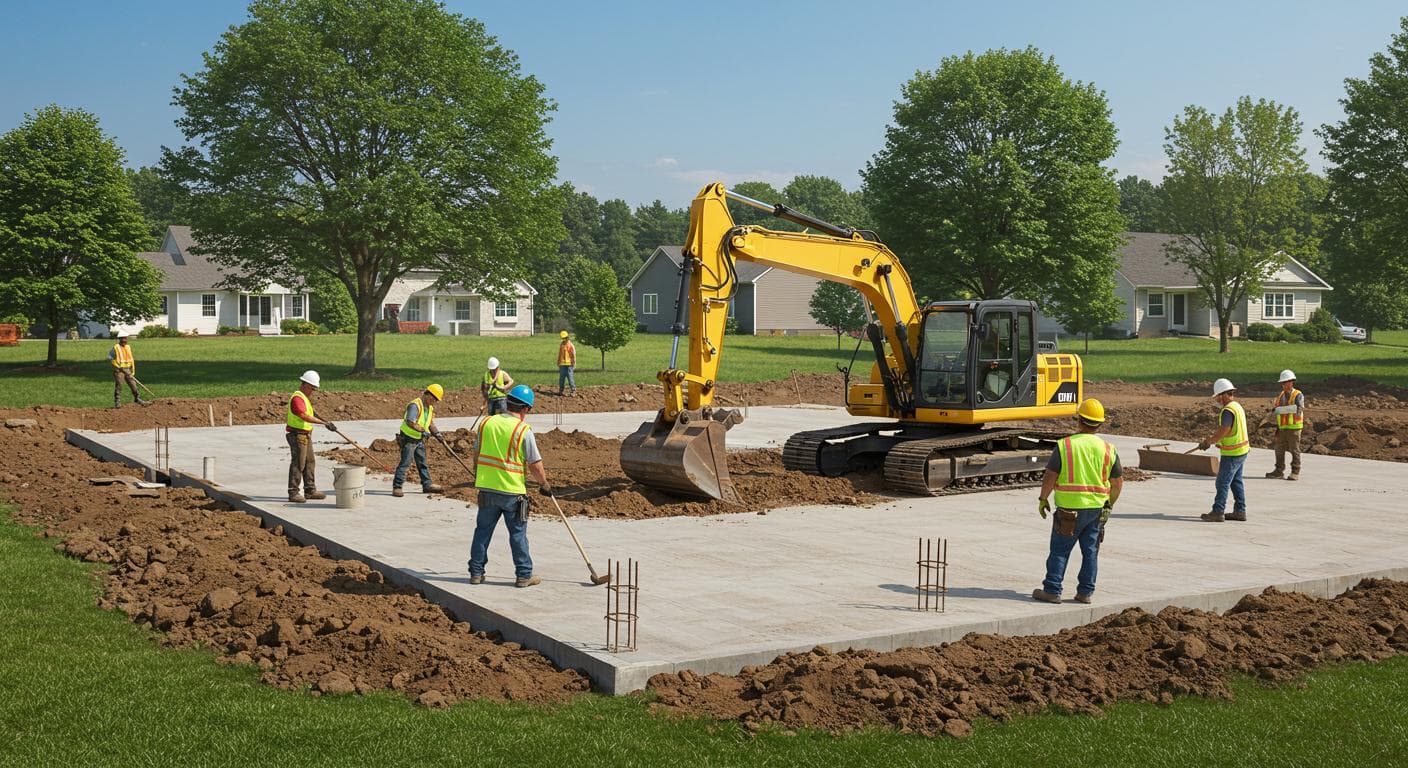
Excavation is the groundwork that makes every other construction project possible, moving, shaping and preparing earth for foundations, drainage systems, utilities, pools, driveways and more. In Ohio, excavation contractors must call 811 (Ohio Utilities Protection Service) before any digging to locate underground utilities, this is state law and a critical safety requirement.
Excavation services include site grading for proper drainage away from structures, basement excavation for new construction, foundation excavation for additions, utility trenching for water, sewer, gas and electric lines, land clearing for new builds, French drain installation trenching and pool excavation.
Ohio's heavy clay soil creates specific excavation challenges: it's difficult to work when wet, can cause equipment to get stuck and must be properly compacted when used as backfill. Many Ohio excavation projects also encounter groundwater, especially in the flat terrain around Columbus, Toledo and the northern tier of the state. Experienced Ohio excavation contractors know how to manage dewatering and select appropriate backfill materials for Ohio's soil conditions.
What homeowners should know.
Excavation Work for Ohio Homeowners and Contractors
Excavation is the critical first step of most major construction projects, foundation pours, basement additions, utility trenching, septic system installation and site grading. Work quality at this stage directly affects every structural element that follows. Ohio's soil conditions vary significantly by region: heavy clay in the Columbus and Cincinnati areas, sandy glacial soils in northwest Ohio and mixed conditions throughout the state. Each requires different equipment, technique and backfill strategy.
Foundation excavation for a new home or addition requires following the engineer's specified bearing depth, typically 4 to 5 feet below finished grade in central Ohio to get below the frost line. Clay soils in Columbus hold moisture and swell, which creates lateral pressure on foundation walls if backfill isn't properly compacted in lifts. A crew that backfills all at once against a fresh foundation wall creates hydrostatic pressure problems within the first 5 years.
Underground Utility Installation and Trenching
Trenching for water, sewer, gas, electric and fiber lines is one of the most common excavation requests in Ohio. OUPS (Ohio Utilities Protection Service) must be called at least 48 hours before any digging: 811 is the number. This call locates buried utilities and is legally required. Excavation that damages unmarked utilities can result in significant liability.
Sewer line replacement and water service line replacement are common in Ohio's older neighborhoods. Cast iron sewer lines in pre-1960 homes are reaching end of life across Cleveland, Columbus and Cincinnati. Trenchless replacement (pipe bursting or CIPP lining) is available where soil conditions and pipe access allow, reducing restoration cost significantly compared to open-cut replacement.
Site Grading and Drainage
Proper grading directs water away from foundations. Ohio's frequent spring rainfall makes grading one of the most important factors in long-term foundation health. Yard areas that drain toward the house rather than away cause basement moisture problems regardless of how well the foundation is waterproofed. Re-grading to achieve positive drainage (minimum 6-inch drop over the first 10 feet from the foundation) is often the single highest-value improvement for a wet basement.
French drain installation, catch basin placement and yard drain systems address localized drainage problems that regrading alone can't solve. These systems require proper outlet locations to daylight or a storm sewer connection.
Excavation Cost Ranges in Ohio
Foundation excavation for a new home (1,500 sq ft, standard depth): $3,000 to $8,000. Basement addition excavation: $8,000 to $20,000 depending on depth and soil conditions. Sewer line replacement (open cut, 50 linear ft): $4,000 to $10,000. Water service line replacement: $2,500 to $6,000. Site grading (1/4 acre lot): $2,000 to $6,000. French drain installation (100 linear ft): $2,500 to $5,000 installed.
Choosing an Excavation Contractor
Verify that the contractor calls OUPS before any work begins and provides documentation. Ask what equipment they're using and whether it's appropriate for your site access. A full-size excavator can do large volume work quickly but may not fit through a standard gate or past mature trees. Compact excavators and hand digging are necessary in tight urban sites. Equipment match to site conditions is a basic competency question worth asking before anyone starts digging.
### What Drives Excavation Cost in Ohio
Excavation pricing in Ohio varies more than almost any other trade because the ground itself is the variable. A crew in Columbus working in well-drained glacial till moves soil fast. That same crew in Cleveland hitting dense, waterlogged lake clay or in Dayton encountering buried limestone ledge works two to three times slower. Understanding the factors that drive your quote up or down protects you from sticker shock.
Soil type and rock content: soft clay or sandy loam costs 60 to 100 dollars per hour to excavate with a mid-size track excavator. Hard pan clay that requires multiple passes or rock that needs hydraulic breaker attachment work, pushes rates to 120 to 180 dollars per hour. Rock blasting, rarely needed in most of Ohio but occasionally required in certain areas along the Ohio River or in eastern parts of the state, adds permits, blast mats and blast-hole drilling costs that can double a job budget.
Depth: anything below 5 feet triggers OSHA's competent-person and shoring requirements. A simple 3-foot trench for a drainage tile in Akron is a different job than a 10-foot foundation excavation in Cincinnati where benching, sloping or a trench box must be used to keep workers safe.
Spoil disposal: the dirt has to go somewhere. If your lot has room for spoil piles that will be used for backfill later, that's free. If the soil is contaminated, unstable or simply excess, haul-off adds 250 to 500 dollars per truckload. A full basement excavation on an average Columbus lot may generate 200 to 400 cubic yards of spoil requiring 10 to 20 loads.
Access: narrow side yards, overhead utilities or fencing that limits machine access forces the contractor to use a smaller machine or hand-dig sections. A mini excavator is slower but fits through a 36-inch gate. Plan access before you get quotes so every contractor is pricing the same scenario.
Site preparation: tree removal, stump grinding, demolition of existing concrete flatwork and utility locates all happen before the first bucket swings. These are separate cost items even if the same company handles them.
### Open-Cut vs Trenchless: Choosing the Right Method for Utilities
Ohio homeowners replacing water or sewer lines face a choice between open-cut excavation and trenchless methods. Each has a legitimate place and knowing the difference saves money.
Open-cut excavation digs a trench along the full length of the pipe run, replaces the pipe and backfills. It's the lowest-cost option when the pipe is shallow, the ground is accessible and landscaping doesn't need to be preserved. Cost for a typical 40-foot sewer line replacement in Columbus: 3,000 to 6,000 dollars.
Pipe bursting is a trenchless method where a bursting head is pulled through the old pipe, fracturing it and simultaneously pulling new HDPE pipe into place. It requires two small access pits, one at each end and no continuous trench. Best for clay tile or cast-iron lines in poor shape where the pipe path runs under a driveway or mature landscaping. Cost: 4,000 to 9,000 dollars for a typical residential run. Not suitable if the old pipe has severe offsets or bellies.
Pipe lining (CIPP, cured-in-place pipe) inserts a resin-saturated liner into the existing pipe and inflates it, creating a new pipe inside the old one. No excavation at all. Best for lines with root intrusion, minor cracks or corrosion where the structural alignment is still good. Cost: 80 to 200 dollars per linear foot. Not suitable for pipes that have already collapsed.
The trenchless premium over open-cut is typically 50 to 80 percent. That premium is worth it if you'd otherwise be tearing up a driveway, killing mature trees or digging through an established garden. If it's open lawn with a shallow pipe, open-cut is the better value.
### Excavation Step by Step for Foundation Work
Understanding the sequence protects your project from delays and cost overruns.
Ohio law requires a locate call to Ohio 811 at least two business days before any digging. This is not optional. The utility companies mark gas, electric, water, sewer and telecom lines with color-coded flags or paint. The cost of hitting a gas line far exceeds any schedule pressure.
The excavator operator first strips topsoil from the footprint, setting it aside separately from subsoil if it will be reused for final grading. This keeps good growing medium available for landscaping restoration.
For a full foundation, benching or sloping begins at 5 feet depth. Ohio OSHA (OAC 4123:1-3-16) requires either a sloped cut at a soil-dependent angle, horizontal benches every 4 feet, shoring panels or a trench box. A competent person on-site must classify the soil to determine which system applies. Ignoring this is how accidents happen on residential jobs.
The cut proceeds to design depth plus a working clearance of 24 to 36 inches on each side beyond the foundation footprint to give the block, poured concrete or ICF crew room to work.
After the foundation is in, waterproofing is applied to the exterior walls and drainage tile is laid at the footing base. Backfill uses granular material (typically 57-stone or clean bank run gravel) against the wall for the first 12 to 18 inches to promote drainage, then compacted fill in lifts. Proper lift compaction, 8 to 12-inch lifts at 95 percent standard proctor density, prevents the settlement that causes basement wall cracks and tilting fences five years later.
### Common Mistakes Ohio Contractors and Homeowners Make
Not getting a soil report for large projects: Ohio's subsurface is wildly variable. A boring or test pit before designing a deep foundation prevents surprise costs that derail projects mid-dig.
Skipping the dewatering plan: most of Ohio has a relatively high seasonal water table, particularly in low-lying areas of Cleveland, Toledo and Dayton. An excavation that goes below the water table without a dewatering pump plan floods, destabilizes walls and delays the concrete crew.
Over-excavating and then filling with compacted material to correct: every cubic yard of fill placed under a footing is a potential settlement point. The rule is to excavate to the designed elevation and stop. Corrections for over-excavation must be specified by an engineer.
Ignoring buried oil tanks and old cesspools: Ohio homes built before 1970, particularly in Cleveland and Akron metro areas, often have buried fuel oil tanks or decommissioned cesspool pits that don't appear on any survey. The Ohio EPA has specific protocols for tank removal and site remediation. Discovering one mid-excavation adds cost, time and regulatory complexity.
### Permits and Code Requirements
Ohio requires an excavation permit for any work deeper than 4 feet in most municipalities. Columbus, Cleveland and Cincinnati all have their own permit offices and inspection requirements. A foundation excavation for a new home or addition requires a building permit that covers the entire project including the earthwork phase.
Excavation within 10 feet of a public right-of-way requires additional notification and often a traffic control plan. Work near public storm sewers requires a separate permit from the county or municipal engineer's office in most Ohio counties.
### Frequently Asked Questions
How long does a typical foundation excavation take in Ohio? A standard residential basement excavation on an average lot takes 1 to 3 days with a full-size track excavator. Complications like rock, utilities, restricted access or poor drainage can extend the timeline.
What is the difference between a trackhoe and a mini excavator? A standard track excavator weighs 12,000 to 40,000 pounds and handles large volume work efficiently. A mini excavator weighs 4,000 to 10,000 pounds and fits in tight spaces. Your contractor should specify which machine is appropriate for the job scope and site conditions.
Does excavation work require an engineer? For residential excavation under about 12 feet in stable Ohio soils, an engineer is not always required. For any commercial excavation, anything near existing structures or any situation involving poor soil or unusual depth, get a geotechnical engineer involved before digging.
Everything a job covers.
How to hire a excavation company near you.
Describe your excavation need, grading, trenching, site prep or clearing, with site dimensions and Ohio address
811 utility locate request submitted, all underground utilities marked before any equipment arrives
Site assessment to evaluate soil conditions, drainage and access for equipment mobilization
Excavation work completed, soil hauled or stockpiled, grade verified with laser level
Backfill and compaction where required, compaction testing available for engineered applications
Excavation Company cost near you.
Prices vary by scope and city. You get a firm quote after describing the job, free, no obligation.
* US average estimates. Final pricing confirmed before any work begins.
Why hire a professional near you.
811 utility locate coordination always completed before digging, no underground utility strikes
Mini excavators available for tight residential access, no tearing up your yard unnecessarily
GPS-grade laser leveling equipment for precise grade verification
Proper Ohio clay soil management, correct backfill selection and compaction for structural applications
Dewatering capabilities for high water table areas common in northwest and central Ohio
Get matched instantly.
Describe the job
Tell us about your excavation project: scope, urgency and your zip code.
We match & dispatch
We find the best available verified pro in your area. No bidding wars, no picking from a list.
Get your free quote
Your pro reviews the job and sends a quote. You only pay once you approve the work.
How to choose the best excavation company.
Excavation contractors in Ohio should carry a general contractor or excavation specialty license and at minimum $1M liability insurance. Ask specifically about their 811 process, any contractor who skips utility marking is creating enormous liability.
For larger projects involving engineered grading or structural backfill, ask whether a compaction test (Proctor test) will be performed, this matters for foundations and retaining walls. Get a written quote that specifies hourly rate, minimum hours, mobilization charge and disposal fees for excavated material.
Skip the comparison shopping. Contractor Palace pre-vets every pro and dispatches the best match, no browsing directories, no bidding wars.
Signs you need this service.
Water pooling in yard or against foundation after rain, grading directs water toward instead of away from the house
New construction planned, foundation excavation is the first step
Installing a French drain, dry well or drainage system, requires trenching
Land clearing needed for new build, addition or driveway expansion
Septic system installation or replacement, Ohio requires proper excavation and soil testing
Pool installation planned, excavation is the largest cost component
Utility line repair or new service installation, water, sewer or gas line work requires trenching
Your privacy is protected
We never expose contractor names, business names or direct contact info on our platform. Communication runs through Contractor Palace until your pro is assigned and the work begins, at which point you get direct contact for your pro. It protects both you and the pro.
Why homeowners trust us.
Excavation Company FAQ.
Do you handle 811 utility marking before digging?
Yes. Ohio law requires calling 811 before excavating. We coordinate all utility markings before any equipment touches the ground.
What size projects do you take?
Everything from a 10-foot drainage trench to full subdivision lot clearing. We have mini excavators for tight residential spaces and full equipment for large projects.
How is excavation priced?
Most residential excavation is quoted hourly ($100-$180/hr including machine and operator) plus material disposal fees. Large projects may be bid per cubic yard.